Showing posts with label Justice-Seeking Movement. Show all posts

Thursday, June 1, 2017

Iran is bulldozing the mass grave from the mullahs' 1988 massacre


Al Arabiya , 10 August 2018-
Taking stock of Iran’s crimes against humanity 30 years after 1988 massacre

On July 26, Amnesty International renewed its warning of many years that the theocratic regime in Iran is destroying all the evidence of 1988 massacre of political prisoners. Since the massacre the only visible proof of it are mass graves where bodies of the prisoners were piled up.
There is also a constant reminder for the rest of us that such heinous crime has not been thoroughly investigated by an independent international commission.
Read more


Iran Regime Destroy Mass Graves as Part of Cover-Up
The Iranian Regime has already begun destroying the mass graves of political prisoners secretly executed by the mullahs’ security forces in the 1980s, despite a plea from Amnesty International to halt the desecration and allow an investigation to take place.
On July 20, some of the relatives of those killed during the 1988 massacre of political prisoners, mainly members of the People’s Mojahedin Organisation of Iran (PMOI/MEK), visited one of the secret gravesites, located behind Behesht-Abad Cemetery in District 5 of the Padadshahr Padad area in the city of Ahvaz, only to find that the graves of their loved ones had been destroyed. The Ahvaz site served as the burial site for those killed during the 1988 massacre and for dissidents killed by the Regime between 1981 and 1984.
Read more

MEK activists expose Iranian regime’s efforts to destroy evidence of mass executions
 In 1988, under the order of Iranian regime supreme leader Ruhollah Khomeini, the Iranian regime executed more than 30,000 political prisoners, the majority being members and supporters of PMOI/MEK.
At the time, the regime needed to eliminate the opposition to consolidate its power at one of its most critical moments. The victims were executed in the span of mere months and their bodies were tossed into mass graves scattered across Iran.
The regime thought it could keep the 1988 massacre silent. Since then, the MEK has tried to bring the world attention to this heinous crime, which the regime has constantly denied. But three decades later, its crimes are catching up with it. Since 2016, an international movement led by the MEK has been documenting and publishing details of the 1988 massacre and exposing the authorities who were involved in the crimes.
Read more


Maryam Rajavi calls for urgent action to prevent destruction of the graves of victims and removing the traces of the 1988 massacre in Iran

Maryam Rajavi, urged the UN Secretary General, the UN Security Council, the UN Human Rights Council, the UN High Commissioner for Human Rights, and international human rights organizations to immediately take action to prevent the Iranian regime’s systematic destruction of the graves of victims  of the 1988 massacre in Iran and removal of the traces of this massacre throughout the country, particularly in Ahvaz.
As the clerical regime’s efforts to prevent the growth of the Call-for-Justice movement has failed and it has not managed to send the massacre of Iranian political prisoners into oblivion, the ruling mullahs are desperately trying to remove the traces for this massacre in a bid to evade the consequences of this genocide and great crime against humanity, Maryam Rajavi added.


ROAD TO BE BUILT OVER INDIVIDUAL AND MASS GRAVES
The families of political dissidents who were forcibly disappeared and extrajudicially killed in Ahvaz, southern Iran, in the 1980s are suffering untold mental anguish and distress as the authorities are destroying the individual and mass graves of their loved ones. They are afraid of facing further persecution if they speak out.


Amnesty International says Iranian Officials Eliminating Evidence of Massacre

The 1988 massacre of 30,000 political prisoners in Iran has been referred to as a crime against humanity by various members of the international community. Members of the Iranian resistance have continued efforts to keep this tragedy in front of the international leadership, along with their calls for justice. The Iranian government has denied the massacre on multiple occasions, despite recordings where key officials admit to participating in the events of the summer of 1988.
Many of the victims, according to witnesses and family members, were buried in mass graves. The locations of these graves are now under attack by the Iranian authorities, as they attempt to wipe out any traces of the massacre within Iran.

CRIMINAL COVER-UP: IRAN DESTROYING MASS GRAVES OF VICTIMS OF 1988 KILLINGS

New evidence, including satellite imagery, shows that the Iranian authorities are deliberately destroying suspected or confirmed mass grave sites associated with the 1988 massacre in which thousands were forcibly disappeared and extra judicially executed

Amnesty international 30 April 2018, For nearly three decades, the Iranian authorities have systematically concealed the whereabouts of thousands of political prisoners, including prisoners of conscience, who were forcibly disappeared and extrajudicially executed in 1988. Amnesty International and Justice for Iran have documented how the authorities have destroyed or damaged mass grave sites across Iran that are believed to contain the remains of the victims. Amnesty International and Justice for Iran call on the authorities to stop the destruction of mass grave sites and ensure that they are preserved until proper, independent investigations can be carried out.

Part 41 of Behesht-e-Zahra
Part 41 of Behesht-e-Zahra: Broken Graves of Political Opponents
Part 41 of Behesht-e-Zahra cemetery is among the most famous burial places where a large number of critics and opponents of the Islamic Republic of Iran, especially the executed prisoners, have been buried. This place has been subjected to destruction and disrespect throughout the years after the revolution. Recently some news of the possibility of further destruction of this part has been published in the media.
According to the report of Human Rights Activists News Agency in Iran (HRANA), you would not see any explanations about the people buried in the graves. Perhaps the most eloquent explanation is the “Broken Tombstones” of part 41.
IRAN REGIME DESTROYS THE GRAVES OF THE MARTYRS OF PMOI/MEK KILLED IN THE 1988 MASSACRE

IRAN REGIME DESTROYS THE GRAVES OF THE MARTYRS OF PMOI/MEK KILLED IN THE 1988 MASSACRE
By Jazeh Miller
While hundreds of international figures and lawyers have called for a trial of the regime's leaders and the perpetrators of the massacre of members and sympathizers of PMOI/MEK in 1988, the Iran regime is trying to destroy the graves of MEK martyrs killed in this crime.
According to the reports from various parts of Iran, the regime has been eliminating the signs of this MEK genocide in several cities including Ahvaz (southwestern Iran), Mashhad (northeast), Isfahan (center of Iran), Tabriz and Ardabil (northwestern), etc. They seek to destroy the mass graves of MEK members so that the families could not pay tribute to their loved ones the way they have been doing for years in various ways such as cementing the graves or removing the garbage and so on.
The Iranian regime also destroyed the mass graves of MEK martyrs in Vadi-e Rahmat Cemetery of Tabriz under the pretext of carrying out construction projects. Moreover, the supporters of the MEK distributed the pictures and videos of grave destruction on the internet on June 23 2018. The news of such crime has been also posted in forms of pictures on Vadi-e Rahmat Cemetery Telegram Channel on September 11, 2017.
As the Iran regime admitted, the construction project includes a total area of 4500 square meters. The procedures consist of excavating operations, rolling, leveling and fitting, pouring concrete, building walls, gridding, installing light pylons. Three companies and the Supervision of Tabriz Civil Engineering Department launched this project and the Cemetery Organization of Tabriz Municipality is the employer.
As the satellite TV of the Iranian resistance, ‘Simay Azadi’ Channel released photos and videos on the destruction of graves, the Iranian regime also destroyed a MEK mass grave in Sowme'eh Sara, Gilan Province. One of the supporters of the MEK who visited this location, reports:
"I went to the cemetery in which the MEK martyrs of the massacre of 1988 are buried. I took photos of the graves of townspeople but I could not find the graves of MEK martyrs. Nevertheless, I saw a mechanical excavator behind the cemetery amidst the tall trees where the MEK martyrs are buried. As the people said, this excavator is operating to make roads."
He added," The cemetery of MEK martyrs is exactly located behind these tall trees, as the supporters of the MEK released pictures of this area. They are currently destroying the cemetery." While a Justice Seeking movement is formed to try the perpetrators of the 1988 massacre of MEK and non MEK affiliates, the Iranian regime intends to eliminate the signs of such brutal crime.

Amnesty International: Stop Iran From Destruction of Mass Grave of 1988 Iran Massacre

NCRI - Amnesty International launched a campaign on Monday calling on the authorities of the Iranian regime to “urgently stop the destruction of a mass grave in the southern city of Ahvaz”.
At least “a dozen political prisoners killed during a wave of mass extrajudicial executions in August and September 1988 are buried” in the mass grave.
A footage obtained by Amnesty International “shows the site is gradually being buried beneath piles of construction waste” after a construction near the area began earlier this year.

Mass Graves

The 1988 massacre gave rise to the phenomenon of mass graves. Every day hundreds
of people in Evin and more in Gohardasht and other prisons in Tehran and in prisons
all over Iran were being executed.

The regime’s agents did not have the time to bury them one by one, so the only way was to bury them in mass graves. This method had been used occasionally in Tehran and other cities since 1981, but in 1988 it became a systematic procedure in the major cities.
A witness recalls: “The scale of the massacre was so vast that bodies of the executed were carried away on trucks to mass graves. I was able to see the truck from between metal window shades covered with a canvas sheet in order to hide the mess.”
Amnesty International: Stop Iran From Destruction of Mass Grave of 1988 Iran Massacre
Iran is bulldozing the mass grave from the mullahs' 1988 massacre
By Hassan Mahmoudi

Since its foundation, by Ayatollah Rouhollah Khomeini, the regime of Iran has succeeded in maintaining its absolute power through the massive use of torture and executions of its citizens. They are now trying to cover up their crimes.
The ugly reality is that thousands of Iranians were sent to the gallows and torture chambers for absurd and preposterous charges of “enmity against God” or “spying for external powers.” In the 1980s, thousands of educated youth of Iran, who had been sympathetic to the opposition groups, were executed by the mullahs. In summer of 1988 alone, based on the decree of Khomeini, 30,000 political prisoners, most of whom were members or supporters of the Mujahedin (PMOI or MeK), were executed.
Four decades of savage suppression by the mullahs has frustrated Iran's people who now look for any opportunity to show their abhorrence for the government. Supreme Leader Ali Khamenei, President Hassan Rouhani and other Iranian officials are, more than ever, frightened of another mass uprising. According to the report from the National Council of Resistance in Iran (NCRI), Amnesty International has launched a campaign on Monday calling on the authorities of the Iranian regime to “urgently stop the destruction of a mass grave in the southern city of Ahvaz.”


IRAN, 17 July 2017--  In an interview with an Iranian regime funded television station, Ali Fallahian, the former Iranian intelligence minister and one of the perpetrators involved in the AMIA bombing that killed 85 people on July 18, 1994 in Buenos Aires, Argentina, revealed the mindset behind the mass execution of more than 30,000 political prisoners in Iran during the summer of 1988.

Iran Regime's Official "Proud" of Role in 1988 Massacre

Earlier this month, a senior judicial official in the Iranian regime has publicly tried to justify the state’s execution of tens of thousands of political prisoners during the eighties.
In an interview with a state news agency affiliated with the Islamic Revolutionary Guards Corps (IRGC), the official - Judge Ali Razini, the head of Branch 41 of the Supreme Court – said that the execution of prisoners in 1988 in what has been named the 1988 massacre was “fair” and “lawful”.
Judge Razini is the head of Branch 41 of the Supreme Court.
During the 1988 massacre, the so called “Death Committee” ordered the execution of political prisoners, many of whom were members or supporters of the PMOI, the banned opposition group. The prisoners’ fate was decided based on their loyalty to the Islamic Republic.
Aerial photo shows that the graves of martyrs have been vandalized and purred concrete over

Photo evince of destruction of 1988 massacre evidence by Iran regime

Aerial photo shows that the graves of martyrs have been vandalized and purred concrete over


PMOI martyrs’ graves vandalized in northwest Iran

During the past few days the mullahs’ regime in the city of Tabriz, northwest Iran, has begun a campaign of vandalizing graves of members of the People's Mojahedin Organization of Iran (PMOI/MEK) executed back in the 1980s, especially those massacred during the summer of 1988. These now destroyed graves were in the Rahmat Valley Cemetery. To this point the graves of 75 martyrs, including Akbar Choopani and Soraya Abolfat’hi, who was executed while pregnant, have been vandalized
Read more
Exposing the Crimes of Desecrating MEK Martyrs' Graves in Tabriz

Following the disclosure of a plan to desecrate the graves of MEK martyrs massacred by the Iranian regime in Ahwaz and Mashhad, the clerical regime also resorted to the same crime in the city of Tabriz, northwestern Iran.
According to MEK supporters, on June 22, 2017, the clerical regime in Wadi Rahmat in Tabriz, where the martyrs of the unknown MEK slain massacred in 1988 are buried, the regime began to raze and demolish the graves of the martyrs using construction machinery.
MEK reporters say that six people were involved in this heinous crime at the site. They removed the stones on the graves and threw them away and then poured 10 centimeters of concrete onto the graves.


In an attempt to cloak its crimes during the 1988 massacre of thousands of political prisoners across the country, Iranian authorities in Mashhad (northeast Iran) have used heavy machinery to cover the graveyard of these victims in a known cemetery, according to reports from PMOI/MEK supporters sent on June 1st.
reports, the clerical regime has planned to demolish and destroy a mass grave in Southwestern city of Ahvaz, which is the burial place of the martyrs of the 1988 massacre of political prisoners. This location, was detected according to people’s reports and martyrs’ families and was revealed by the Iranian Resistance Satellite TV.
Read more
Amnesty International:Iran Desecrating mass grave site would destroy crucial forensic evidence
In other report Amnesty International on 1 June 2017 mentioned:
The desecration of a mass grave site in Ahvaz, southern Iran that contains the remains of at least 44 people who were extrajudicially executed would destroy vital forensic evidence and scupper opportunities for justice for the mass prisoner killings that took place across the country in 1988, said Amnesty International and Justice for Iran. 
Photo and video evidence obtained by the NGO Justice for Iran and reviewed by Amnesty International shows bulldozers working on a construction project directly alongside the mass grave site at Ahvaz, as well as piles of dirt and construction debris surrounding the grave. Although the Iranian authorities have made no official announcements about Ahvaz, families learned through a construction worker that the plan is to ultimately raze the concrete block marking the grave site and build over the area. 

Related:


Maryam Rajavi remembers the anniversary of the 1988 massacre of political prisoners in Iran

Maryam Rajavi’s message to the Berlin gathering Commemorating victims of the 1988 massacreAguest 29, 2015


Follow  Freedom for Iran on

https://plus.google.com/u/0/115000766128351373575

Facebook
https://www.facebook.com/freedomforiniran.blogspot.al/

Freedom4Iran
@FreeIransyria


Saturday, November 26, 2016

A Call to Strip Immunities of the Perpetrators of the 1988 Massacre in Iran


Maryam rajavi:
The bill passed by US House of Representatives, mandating sanctions on the Iranian regime and officials responsible for #HumanRights abuses is a necessary response to the world’s top rights violator. I hope it is rapidly adopted as law and enforced.
Khamenei, Rouhani and other Iranian regime officials must face justice for 120,000 political executions and the massacre in 1988.


U.S. Congress New Legislation: Yet Another Achievement By The Movement Seeking Justice For The Victims Of The 1988 Massacre
By Mahmoud Hakamian 
On Thursday April 26, 2018, the US House of Representatives passed H.R.4744 Act --holding the Iranian regime accountable for its brutality—with an overwhelming majority of 410-2.
The bipartisan legislation holds Iranian regime officials accountable for their role in human rights abuses and hostage-taking, and requires imposition of sanctions against them. The bill also condemns and calls for investigations into the 1988 mass executions of 30,000 political prisoners.
Previously passed by the Committee on Foreign Affairs of House of Representatives in March 2018, the legislation now has to pass the Senate and also be signed by the US President to turn into law.
Considering its bipartisan nature and the fact that it’s been passed with an absolute majority, it’s expected that the legislation won’t be faced with any real challenge before being enacted, following which the US President is obliged to submit a report to appropriate congressional committees within 270 days after the bill’s enactment date, determining senior officials of the Iranian regime who are responsible for human rights abuses, according to the criteria described in previous legislations.
Read more

Secretary General of the U.N. Reports on the Situation of Human Rights in Iran

The Secretary-General of U.N. transmitted to the General Assembly the report of the Special Rapporteur on the situation of human rights in Iran, which has been submitted in accordance with Human Rights Council resolution 34/23.
During its thirty-third session, the Human Rights Council appointed Asma Jahangir as Special Rapporteur on the situation of human rights in Iran. The present report outlines the activities carried out by the Special Rapporteur since the issuance of her first report to the Council (A/HRC/34/65), examines ongoing issues and presents some of the most recent and pressing developments in the area of human rights in the country.
It is noteworthy that recently Mrs. Maryam Rajavi the President Elect of the National Council of Resistance of Iran, in her speech on the anniversary of 1988 massacre of political prisoners in Iran stated: ‘It is essential that the UN Security Council refer this case to the International Criminal Court to arrange for the prosecution of the regime’s leaders and those responsible for the massacre. How the international community approaches this genocide and this crime against humanity is a litmus test of its adherence to the principles of human rights.
The following are excerpts of this report and relevant articles examining the violation of Human Rights specially the 1988 massacre of the political prisoners, mostly members and sympathizers of the PMOI/MEK. The titles for each article are chosen by us to clarify the subject of each paragraph an are not a part of the main report.
Read more
Struan Stevenson

TRIBUTE TO VICTIMS OF 1988 MASSACRE IN PARIS

by-Jazeh Miller
Former member of the European Parliament and chair of Friends of a Free Iran, Struan Stevenson, has campaigned for freedom in Iran for many years. He spoke at the exhibition in Paris commemorating the anniversary of the atrocious 1988 massacre in Iran.In his speech at the City Hall of the first district in the city, Stevenson called for a comprehensive United Nations inquiry into the crime against humanity in which more than 30,000 political prisoners
were executed following a fatwa issuedby Iran’s Supreme Leader at that time.

Read more
Call on U.N. : Nobel Laureates Condemn Executions by Iran Regime Perpetrators Must Be Held Accountable

A group of Nobel laureates expressed grave concerns over continuing human rights violations in Iran. 21 Nobel laureates from the United States, Canada, Germany and Norway issued a letter asking United Nations Secretary General Antonio Guterresto to use his good offices “through the UN Human Rights Council to closely monitor the human rights situation in Iran, inform the world of the violations taking place in that country and to strongly condemn such violations … ” and “an immediate halt to intractable arrests, torture and arbitrary executions. The perpetrators of such executions must be held accountable.” Pejman Amiri an Iranian dissident and freelance writer wrote in an article in ‘NewsBlaze’ on July 22, 2017
Read the article click here

Legacy of a dictator: Iran's 30,000 murdered, then and now

By Hassan Mahmoudi July 14, 2017-- In the wake of the 30th anniversary of the massacre of 30,000 political prisoners in summer of 1988 in Iran, the people of Iran and especially families of the victims are still waiting for justice and an international tribune.
In the summer of 1988, the political prisoners were systematically executed in almost two months.  In a barbaric two-month purge, prisoners, including teenagers as young as 14, were loaded onto trucks in groups and hanged from cranes.
During the past three decades, the regime blocked all attempts to investigate the extent of the massacre.  They even went farther to cover up the crimes by toppling and damaging cemeteries and headstones of martyrdom graves with bulldozers.
Read more

THE U.S. RESOLUTION 188 PASSED TO CONDEMN THE 1988 MASSACRE OF POLITICAL PRISONERS IN IRANUS 

Congress Resolution Condemns Iran Atrocities and Calls for Actions  
By: Dr. Majid Rafizadeh Huffington post , Jun 9, 2017-                       A resolution was recently introduced in the U.S. House of Representatives, condemning an atrocity that most Americans, and indeed most westerners, have never heard of: the 1988 killings of approximately 30,000 political prisoners in Iran  
READ MORE

U.S. Congress Sponsors Resolution Seeking Justice for MEK Members Massacred by Iran Regime in 1988

Sir David Amess A Call to Strip Immunities of the Perpetrators of the 1988 Massacre in Iran
The Senior Member of the House of Commons and the Joint Chair of the British Parliamentary Committee for Iran Freedom, Sir David Amess on Thursday March 3rd issued an statement by undertaking a meta-partisan initiative in line with the international movement with 80 Members of parliament for justice for litigating those who are responsible for the massacre of 30 thousand political prisoners occurred in Iran in 1988.Read more

Related articles:

Al Khaleej Online: Maryam Rajavi says that defeating ISIS depends on stopping Iranian regime’s interventions in the region

Saudi Arabia’s Daily Al-Riyadh: Maryam Rajavi Said the World Should Act Against Iran Regime

Maryam Rajavi: Call for Justice; Ending Impunity for Perpetrators of Crimes Against Humanity In Iran and Syria
A Syrian song is being performed by Syrian girls about their suffering.

The text of Maryam Rajavi's remarks In a Conference Call for Justice" gathering at Paris's Mutualité Hall – Nov. 26, 2016

Some part of the Maryam Rajavi's remarks
Now the mullahs who plotted extensively to destroy all the members of the PMOI at Camp Liberty, have suffered a serious setback and there is not a day when they do not lament about the danger of the PMOI's resurgence within Iran.
Another sign the Resistance's rising phase is the escalation of popular protests and strikes in Tehran and other major capitals of Iran.
Some weeks, there are ten protests held in front of the mullahs' parliament. Bazaar merchants are on strike in a number of cities. Students stage protest gatherings at their universities. Political prisoners stage hunger strikes in Tehran's Evin Prison, Gohardasht Prison in Karaj and in prisons of other cities.
This is what our people want: This situation needs to be changed from despotism, poverty and regression to freedom, happiness and progress.
Today, the mullahs from both factions of the regime have failed to achieve their most important objectives in signing the nuclear agreement.
Yet, the nuclear agreement that could be the regime's way out of its crises has now become counterproductive. Khamenei describes it as "pure damage" while Rouhani's promises for the post-JCPOA era have proven to be hollow.
The US policy on Iran and the region during this time was based on rapprochement with the mullahs despite countless disastrous fallouts, including a devastated Iraq, a blood-drenched Syria, and the blocking of the road to change in Iran. It is not without reason that the ruling mullahs are so frightened by the approaching end of what they describe as a "golden era."
We have said this time and again since years ago, and I will repeat it again that the worst mistake of the United States in the region was its appeasement of the mullahs ruling Iran. From now on, the region would move towards peace and tranquility to the extent that the US distances itself from this disastrous policy. Likewise, the European Union may have a positive impact on the situation in Iran and the Middle East to the extent that it conditions the EU's political and commercial relations with Tehran on end to executions.
Let me sum up what our expectation, our people's expectation, and the expectation of the peoples of the Middle East from the international community are.
Our demand is that the international community merely stops its policy of giving concessions to the Velayat-e Faqih regime. Our demand is to end this silence and inaction over the crimes of the Iranian regime in Iran and the region. What we want instead is their respect for the Iranian people's quest for freedom.
Today, Khamenei has ever more strongly tied the fate of his decadent regime to the carnage of the people of Syria
The war in Syria has nothing to do with the people of Iran and the Iranian interests.
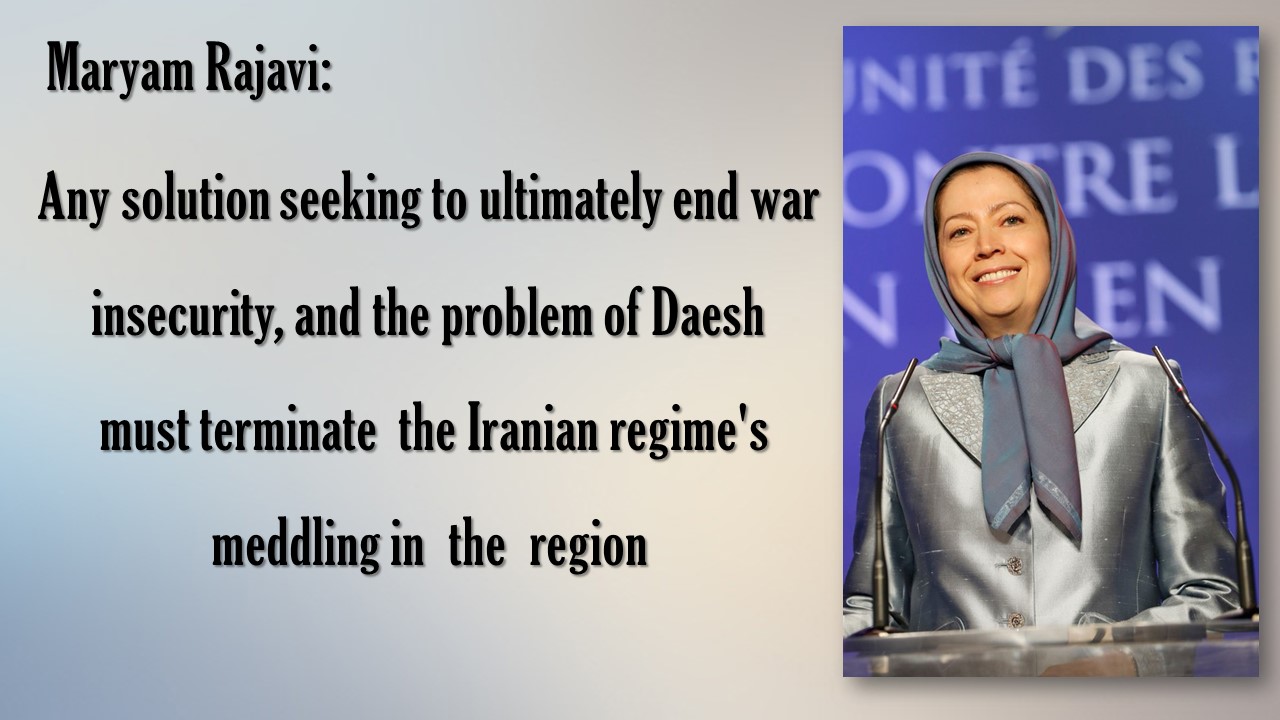
As for the present crisis in the region, any solution seeking to end war and insecurity, and address the problem of Daesh (ISIS/ISIL) in particular, must consider terminating the regime's meddling in the region and especially in Syria. Nothing is more catastrophic than cooperating with the Iranian regime to fight Daesh. This would strengthen the Iranian regime and its terrorism, and would nourish Daesh, politically and socially.
This movement relies on its own and its people's suffering and sacrifice. This principle has always illuminated the road for this movement. Fighting on, tirelessly paving the way, path breaking by making sacrifices, and deploying amazing determination of human beings move us along the road to victory.

A Historic Judgment on the 1988 Massacre of Political Prisoners in Iran

Sir Geoffrey Robertson, QC, former UN tribunal chief judge on Sierra Leone and prominent human rights barrister :
We can’t progress as a world society unless we do something about the worst unpunished atrocity in modern society since the Second World War
following is the full text of his speech.

Bishop Jacques Gaillot Calls for Justice for 1988 Iran Massacre Victims

Bishop Jacques Gaillot Calls for Justice for 1988 Iran Massacre Victims

Bishop Jacques Gaillot, a clergyman and social activist, said that the search for justice for the tens of thousands of victims of the 1988 massacre needs to continue.

Here is a translation of his speech:

Text of the Washington Times report: 

The two dissidents, Shabnam Madadzadeh, 29, and Arash Mohammadi, 25, told Rowan Scarborough of the brutality they had faced in taking part in public protest. Both were smuggled out of Iran via a clandestine network operated by the People’s Mujahedeen of Iran (MEK).

Iranian dissidents reveal prison brutalities

Shabnam Madadzadeh:a former political prisoner who secretly left Iran few months ago revealed atrocities of the Iranian regime inside prisons. She was 21 when arrested for her activities in a university in Tehran.
 “Today, I stand in front of you to echo voices that seek justice and human rights, the voices of the activist and perseverant political prisoners in Iran. I echo the voice of my Christian and Bahai compatriots, whom the regime continues to imprison simply on the basis of their faith; the voice of the resilient women in prisons; The voice of my dear sister and my hero Maryam Akbari Monfared; an innocent mother of three who has spent more than 7 years in the regime’s prisons. When they arrested her, her daughter Sara was only four. But, even in the darkest and most difficult days, Maryam refused to surrender.
Text of speech of Shabnam Madadzadeh

Arash Mohammadi, a 25-year-old former political prisoner and student activist is now on the stage to address the Paris conference. He was arrested in Iran numerous times for his activities against the mullahs' regime and in support of the PMOI between 2011 and 2014 and subjected to barbaric torture and inhumane treatment. He was realeased from prison in June 2014 and recently escaped Iran to join the Resistance and is here with us today.

Iranian dissident who revealed prison brutality in Islamic Republic smuggled into Europe

Farideh Goudarzi and her son Iman Afsahi, ex-Iranian political prisoners, 
Farideh spent over six years in prison in the 1980s and was witness to the 1988 massacre. Her son Iman was born in prison and her husband was executed by the mullahs' regime. Iman who was born in prison, was himself arrested and held in Evin Prison in recent years, they have both escaped in the past few months from Iran.
Farideh goudarzi
Farideh goudarzi
Farideh goudarzi
Rob Roberts is a UK-born journalist living in Paris he wort a good article and report about Call for Justice; gathering
The President-elect of the Iran resistance has reasserted her support and solidarity of the Syrian opposition’s struggle to end Assad’s bloodshed saying that the ‘Syrian people are not alone.
On Saturday November 26, a group of political prisoners in Iran in a letter addressing the organizers, guests and participants in a conference held on Saturday in Paris that called for accountability of the perpetrators of the 1988 massacre in Iran.
The following is the excerpts of the letter

Related:


Maryam Rajavi remembers the anniversary of the 1988 massacre of political prisoners in Iran

Maryam Rajavi’s message to the Berlin gathering Commemorating victims of the 1988 massacreAguest 29, 2015


Follow  Freedom for Iran on

https://plus.google.com/u/0/115000766128351373575

Facebook
https://www.facebook.com/freedomforiniran.blogspot.al/

Freedom4Iran
@FreeIransyria

Sunday, November 13, 2016

Iran-Iranian people,Join Justice-Seeking Movement


Families Demanding Justice for 5,000 Political Prisoners Slaughtered by Iran’s Ayatollahs
Almost 30 years have passed, and Iran’s government would like people to forget the atrocity it committed. But the memory only grows more bitter, even among those unborn in 1988.
The families of political prisoners executed in the 1980s have appealed to the United Nations to publicize the truth about one of the Islamic Republic’s most horrific crimes against its people.
Fifty Iranian citizens whose family members were killed in mass executions have written to Asma Jahangir, the U.N.’s special rapporteur on the human rights situation in Iran. They appealed to Jahangir to work with the U.N.’s Working Group on Enforced or Involuntary Disappearances to clarify what happened—and to force the Islamic Republic to acknowledge the crime. The letter demands those responsible for the mass executions be tried in a public court, and be charged with violating Iran’s constitution and the Universal Declaration of Human Rights.
Mothers of the Iranian Martyrs Demand Trial of the Regime Leaders for the 1988 Massacre

NCRI - Mothers of Laleh Park which include mothers of the martyrs of 1988 massacre of 30,000 political prisoners in Iran and mothers of the martyrs of 2009 uprising and political prisoners who were executed in recent years have issued a statement on Thursday 31 August 2017 calling for trial of the Iranian regime’s leaders for the massacre of the political prisoners in the summer of 1988.
They emphasized in the statement that to achieve freedom and democracy in Iran, there is no way other than putting on trial and bringing to justice the masterminds and perpetrators of the mass executions of political prisoners in the 1980s and all other crimes committed by the leaders of the mullahs’ regime.
Mothers of Laleh Park also supported in their statement the legitimate demands of the hunger striking political prisoners in Gohardasht prison.
Statement by Dr. Mohammad Maleki , on the Anniversary of 1988 Massacre

“I will not give up campaigning for justice for victims of 1988 massacre to my last breath”
Dear compatriots, young Iranians and university students,
About a year has passed since the revelation of the audio file of the late Ayatollah Montazeri, which exposed an episode that he described as an historic crime. This audio file conveyed many secrets as the ayatollah’s voice reached millions of Iranian men and women for the first time.
In sharp and unequivocal terms, Montazeri talked about some facts of the summer of 1988 massacre that shocked the world. His remarks exposed the “Death Committee” and its crimes, so the world would see what has happened and is still happening to Iranians under the rule of the Islamic Republic. The world now sees how tens of thousands of the best men and women of Iran were sent to death squads simply for being steadfast in their belief and critical of the regime. This revelation had such an impact on every corner of the world that the issue was once again revived in all human rights circles.
Teacher's Union Calls on the UN to Investigate on 1988 Massacre                    NCRI - On Saturday, August 26, a spokesman for Iranian Teachers Union called on UN Secretary General Antonio Guterres and the UN Special Rapporteur on Human Rights in Iran, Asemeh Jahangir, to investigate the 1988 massacre of 30,000 political prisoners.In his letter, Seyed Hashem Khastar, a former political prisoner, described the 1988 massacre of political prisoners in Iran as "a deep wound on the body of the humanity and the Iranian society." He also called on the UN to bring justice to the perpetrators of this crime so this wound heals.

#SholehPakravan,mother of #ReyhanehJabbari flee #Iran &join D #movement #Calls4justice 4 #1988Massacre victims & #opposition 4 #regimechange 
It is a part of the radio program, "The Cross in the Desert," By my dear firend Randy L Noble:
He shared the incredible good news of Shole Pakravan and her daughter Shahrzad being granted asylum status in a European host country. After many grueling months of waiting and uncertainty, they will now be safe and free from the oppressive government of Iran.
 political prisoners massacred in 1988 in Iran

The Youth,,Join Justice-Seeking Movement

group of youth in Kermanshah (Western Iran) have supported the Iranian people’s justice-seeking movement.
Commemorating the courageous MEK/PMOI political prisoners massacred in 1988, they stressed that the perpetrators as well as instigators in the inhumane crime be put to trial.

Parts of the statement reads: 

Kurdish youths and students call for condemning the 1988 massacre

Justice-Seeking movement for massacred prisoners in 1988 is taking peaks and expanding day by day.

Dr. Mohammad Maleki, the first President of Tehran University after the anti-monarchic revolution in Iran, in an interview that was published on the internet says Justice-Seeking movement for massacred prisoners in 1988 is taking peaks and expanding day by day.

The following is excerpts of his interview:
Dr. Mohammad Maleki


Mothers demand prosecution of perpetrators of 1988 massacre
We demand prosecution of all officials engaged in 1988 massacre
Mothers of Laleh Park in their statement demanded details of the summary trials and the mechanism of issuing the death verdicts, places of burial, and the last wills of the victims
Mansoureh Behkish
Mansoureh Behkish, a human rights activist and a relative of political prisoners massacred in 1988 in Iran, announced that she and her friends commemorated the victims of the 1988 massacre in Khavaran cemetery.
Almost 30 years past this horrible crime against humanity, Khavaran where many of the victims were buried in mass graves remains under tight control of security forces. However, many families and human rights activists risk their own security to continue their annual tribute to Iran's best children who gave their lives for freedom.
Ms. Behkish wrote, “On July 22, 2016, we spent an hour in Khavaran laying new flowers on their graves and commemorating them. Then we sang the Khavaran anthem
Reed more 
Mohammad Najafi

 Attorney at law on the 1988 massacre: Khomeini was Imam of law or lawlessness?

Horrifying eyewitness memories of a political prisoner on the 1988 massacre in Iran


group of youths from Ardabil


Mothers of the victims of popular uprisings in Iran in 1999 and 2009, joined the families of the political prisoners massacred in 1988, in a joint ceremony in Khavaran Cemetery. They laid flowers on the unmarked mass graves and commemorated those fallen for freedom in that cemetery tightly controlled by the Iranian regime's security forces.