Showing posts with label Mashhad. Show all posts

Friday, May 4, 2018

#Iran,reports& #news of #strikes& #protests on May 2018


I will pest live in this page
************
Strike Of Truck Drivers – Bond To Iranian People’s National Resistance And The Political Alternative

May 31, 2018 -10th day of truck driver strike 
These protests have now engulfed 271 cities and towns throughout all 31 provinces 


Kermanshah, western Iran
Taxi drivers joining the truck drivers' nationwide strike, continuing into the 10th consecutive day on Thursday.
This goes against rumours spread by the regime in social media of the strike coming to an end.
In spite of Iranian regime’s suppressive measures, truck drivers’ enter the second week of their prote
Steel truck drivers in Hamedan, along with drivers of construction machinery, all joined the truckers’ nationwide strike. Ahvaz, Mahshahr, Bukan and Isfahan were also cities where continuous reports are incoming from activists and the drivers themselves.Drivers lining up their trucks when joining the strike
In various cities taxi drivers and other hard-working people were seen supporting the truck drivers’ strike.
Iran's regime is using military trucks to break the will of the drivers & their ongoing nationwide strike bus drivers are calling for a strike starting Saturday, joining their truck driver colleagues.
The Iranian resistance calls on the public, especially the courageous young people throughout the country, to work in solidarity with the strikers and support the detainees, and calls on all international human rights organizations, labor unions and international transportation agencies to condemn repressive measures against striking drivers and to take immediate and effective action to release the detainees.
Several members of the regime’s parliament members have confessed to the consequences of the catastrophic livelihood of truck drivers: "More than 500,000 drivers across the country express their dissatisfaction and stage gatherings in some cities" (Farhang state radio, May 27).
The heavy vehicle drivers continue their strike while the regime has resorted to deceptive and divisive measures in a bid to end the strike. "According to an agreement, drivers and truckers will resume their work in the freight sector today," said Abdol Hashem Hassan Nya, Deputy Minister of Road and Urban Development, adding, "Representatives of the drivers’ guild associations accepted to continue to work and end the strike; … and part of the demands of drivers and truckers ... will be pursued." (ILNA state news agency- May 28).

All pledges and pretexts resorted to by the Iranian regime’s authorities, aiming to end the strike, have bore no fruit to this day and numerous reports from a variety of cities indicate the strikes continue unabated.
Read more

May 28, 2018 -
Iran protests reported in Tehran & other cities
drivers of the Tipax transportation company in Tehran refused to deliver any loads and announced their solidarity with the country’s protesting truck drivers.

Tehran truck drivers on strike were also seen blocking the road to Khavaran.

An atmosphere of increasing protests throughout Iran is intensifying as people from all walks of life are joining these rallies and gatherings.
In Tehran, a group of part-time teachers and Agriculture Insurance Department employees rallied outside the Iranian regime’s parliament on Sunday seeking immediate answers to their demands.
The teachers were seeking their long-delayed paychecks and to be officially hired by the Education Ministry. Currently, they have no guarantees in their jobs and are literally considered dayworkers.
The Agriculture Insurance Dept. employees were protesting poor living conditions.
In Ahvaz, southwest Iran, retired Khuzestan Steel Company employees staged a protest gathering outside the city’s Retirement Fund office seeking their demands answered.
As truckers across the country continue into the seventh day of their nationwide strike on Monday, minibus drivers in Yazd (central Iran) held a rally protesting skyrocketing prices and supporting their trucker colleagues. Truck drivers in Yazd also held a protest rally on Sunday.
With no end in sight for the ongoing strikes, various parts of Iran’s economy are feeling the impact.
A cement factory in Khash of Sistan & Baluchistan Province was completely closed down on Sunday. Truck drivers in this city are amongst the thousands on strike.
Incoming reports indicate a variety of cities are facing major gasoline shortages as truck drivers refuse to back down from their demands. Locals are supporting the truckers’ strike and becoming furious at Iranian regime officials.
In response, the regime’s Intelligence Ministry summoned truckers’ union leaders in numerous cities on Sunday morning, demanding they announce the end of their strike on social media.

Intelligence officials resorted to threats and Iran’s truckers showed strong will by refusing to back down from their demands.


Nationwide truck drivers strike into its 7th day on Monday
Reaching 257 cities and towns throughout all 31 provinces 

In spite of these repressive measures, the freight terminals in various cities are half-closed, and drivers refuse to load and with lining up their trucks along the roads, demand for a solution to their problems. In Akbarabad Kovar (Fars province), 400 trucks drove to Shiraz while honking in support of the strike. In Ardabil, truckers prevent passage of loaded vehicles. In Ilam, the IRGC moves fuel using municipal vehicles and escorts.
On Sunday, Taxi drivers and taxi owners in Tehran, in solidarity with truckers’ strikes, protested against low fares and expensive spare parts. In Yazd, minibus owners also gathered in protest over expenses and in solidarity with striking truckers in front of the municipality.


Funeral Ceremony of a Popular Movie Star in Iran with the Slogan "Death to the Dictator"

On Sunday, May 27th, the funeral ceremony of the famous Iranian cinema star Naser Malek Motiei, with the participation of a big crowd of the Iranian people and the fans of this late artist, turned into an anti-regime demonstration. The participants who were angry with the regime's anti-Iranian and anti-art treatment of Naser Malek Motiei chanted: "Death to the dictator, Hail to Naser”; “Our disgrace is our (state) radio and TV”.

Naser Malek Motiei was one of the most prominent actors in Iran's cinema who was deprived of his artistic career for four decades and was isolated by the regime due to his failure to accede to the regime’s anti-popular policies. He passed away on Friday, May 25, 2018, at the age of 88.

In fear of spreading this funeral and anti-regime protests, the repressive forces attacked the crowd by sending anti-riot forces and tried to disperse the people by throwing tear gas and shooting in the air. The people confronted the mercenaries and continued their ceremony while chanting: “Shameless, shameless”; “State Security Force is our shame”.


Truck drivers across Iran are continuing their nationwide truck drivers and spread to more parts of the country covering 224 cities in all 31 provinces of the country. Strikers in many cities parade with long lines of trucks by honking and keeping their headlights on.

The clerical regime continued to crack down on strike yesterday. Repressive forces attacked striking drivers in many areas, such as Bandar Abbas-Sirjan route, Islamabad Gharb, Malekan, and Hamedan, with electric shockers and tear gas, wounding and injuring a number of them.

On Saturday, farmers of Varzaneh in Isfahan province rallied their tractors to support the strike of truck drivers. In Robat Karim, 280 passenger bus drivers joined the strike, and in Tehran, a number of taxi riders supported striking drivers by gathering on Gandhi Street. Taxi drivers of the Snap Internet Company, who are protesting their low wages and the dire situation of their livelihoods, joined the protests.

Maryam Rajavi Hail to the drivers of trucks and heavy vehicles in #Iran who have continued their nationwide strike for five days despite the regime’s repressive measures. Backed by their people, they are aware of their own power and have terrified the mullahs’ regime by their strike.


On Saturday May 26, students at Zahedan Azad University protested against insulting and humiliation of Baluchi citizens and Sunni Muslim rituals, and many groups of Zahedan people joined the protest by chanting "Do not be afraid, we are all together." It was written on the protesters' banners, “No to religious and ethnic insults.” Anti-riot security agents arrested a number of students at university attacks.
Maryam Rajavi, saluted the noble Baluchi compatriots and students and youth who have risen in Zahedan today, and said: "Shame and hatred for the clerical regime, which is the main source of discrimination and disunity in Iran today." She called all of the youth, especially in Sistan and Baluchestan province, to help and express solidarity with the students and youth of Zahedan.

Iran truck drivers on fifth day of nationwide strike
reaching 177 cities and towns throughout 29 provinces 
– New footage


Iran, May 26, 2018 - Truck drivers across Iran are continuing their nationwide truck drivers strike into its fifth day on Saturday.
More cities are joining this massive effort, already inflicting severe impacts on the Iranian regime’s economy, reaching 177 cities and towns throughout 29 provinces after the fourth day, and covering all of Iran.

Reports from the Bandar Abbas-Sirajn highway in southern Iran indicate state police attacking the protesting  truck drivers using tear gas and electric shockers. A number of the drivers at the scene are now wounded and injured.

Videos have also arrived from the cities of Tehran, Mashhad, Hamedan, Bushehr, Zahedan, Kerman, Kermanshah, Robat Karim, Neka, Borujen and Divandareh show dozens of other truck drivers also on strike.

1,700 fuel trucks in Isfahan Province alone are on strike.

Various media outlets in Iran are claiming an end to this general strike, while activists report these are fake reports and truck drivers have shown no sign of succumbing to the regime’s demands or hollow promises
On Thursday, May 24th, the nationwide general strike, of truck and heavy vehicle drivers continued in different cities of the country for the third day. The strike has already spread to 168 cities in 29 provinces of the country, and the queues of trucks that have rejected to load goods are getting longer continuously. This is despite the fact that intelligence agents have been deterring them from engaging in strikes since the very first day in various ways, including sending threatening SMS messages on the drivers’ mobile phones, and summoning some of them to the branches of Intelligence Ministry in their cities.

On the other hand, such a major strike, especially considering its growing and organized nature, proves once again that the Iranian regime’s policies are focused on nothing but stealing from the people for their own benefits. Even Iran’s transportation network, considered a vital aspect of the country’s entire economy, is very ill and the drivers very angry.
All the while, the Iranian regime is known to provide 6 to 15 billion dollars to Syria’s Assad regime alone to launch endless massacres against its own people and maintain its rule intact. The Iranian regime is providing for all such expenses, and even its own crackdown machine inside the country, by reaching deeper and deeper into the Iranian people’s pockets, now including truck drivers, by raising the price of their fuel and spare parts, increasing commission fees and…
However, the most important characteristic of this strike is how it is expanding throughout the country based on a high spirit of solidarity among those involved in this movement. Such a spirit was also witnessed back in the Dec/Jan uprising, continuing today in daily protests seen in Varzaneh of Isfahan, Khuzestan, Kurdistan and Kazerun.
This raises alarm bells of more dangers to come for the ruling dictatorship in Iran.
As a result, this nationwide strike will increase the Iranian people’s spirits against the regime and also plunge morale among the Iranian regime’s forces. In the bigger picture, the ruling mullahs will see their hands weakened and become even more fragile against a nation that seeks to overthrow their entire existence.


Iran Protests Update - Tuesday, May 22nd


Shahroud [Shahrud] locals against relocation of Road & Const. Dept.

Reported by PMOI/MEK inside Shahrud
Iran, May 20, 2018 - For the third consecutive day a large crowd of locals in Shahroud, northeast Iran, rallied in the city on Sunday, protesting plans by authorities to transfer the city’s Road and Construction Department to Semnan, the capital of their province.
Demonstrators were seen gathering at the entrance of the city market located on “22 Bahman” Street.
All store-owners and bazaar merchants in Shahroud’s fruit market have closed their shops and joined the protesters’ ranks.
Saturday’s demonstrations saw protesters completely blocking the 22 Bahman Street and continuing to express their protests throughout the city.
Protesters had also rallied on Friday night.
Iranian regime authorities are now pointing fingers in this regard, concerned these protests in Shahroud will gain strength, similar to the scenes witnessed in Kazeroun, southern Iran.
Shahroud is the largest city in Semnan Province, with access to the east and west parts of this governorate. As a result, placing the provincial Road and Construction Department in this city is completely logical and transferring it to another city has raised protests and tensions amongst the locals.

Kazerun protests: The bigger picture

On Saturday, May 19, the people of Kazerun, continued their uprising against the suppressive regime's actions and killing and detaining their children by chanting “My detained brother must be freed!”, gathering and protesting in Shohada Square and in front of the judiciary of the mullahs regime. Kazerun shopkeepers also closed their shops and the pressure of intelligence agents to force them to open the shops did not succeed. The regime's agents, especially the intelligence agents, were deceptively trying to end the protests, but people are demanding the delivery of the bodies of the

martyrs and the release of the arrested. A number of protesters were martyred during a demonstration of the people of Kazerun on Wednesday that became bloody by shooting of the repressive forces. Ali Mohammadian Azad and Omid Yousefian are two of the martyrs of Kazerun's uprising. Omid Yusefian, who was shot on Wednesday by the Revolutionary Guards, died on Saturday due to the severity of the injuries sustained.

On Friday, the risen people of Kazerun turned the city into a scene of confronting the totality of the oppressive apparatus of the clerical regime. Revolutionary Guards, Basijis, plainclothes and anti-riot guards, who were sent from other cities to Kazerun, were deployed in the city's central locations and closed streets leading to Friday's prayer show. Nevertheless, the risen people broke up the hypocritical Friday prayer’s show by chanting slogans. The gathering in the Al-Nabi mosque, where the governor was supposed to speak, was disrupted with the slogan "The incompetent governor must be executed!” The attacks of repressive forces on protesters on the Shohada Street led to widespread street clashes and skirmishes. By burning tires, people blocked the path of repressive forces’ vehicles and defended themselves with stone and wood and breaking the mosaics of the streets.
In blind attacks, the mercenaries broke the glasses of parked car windows in parking lots. During the clashes on Thursday and Friday, a number of repressive forces’ vehicles and several centers of looting and government crackdown were set on fire.

The protests continued Friday night until Saturday morning. In Simashahr Square, people chanted slogans against the mercenary attacks: “Do not be afraid we are all together; and we are children of war, let’s fight”. At Quds intersection, the shooting of repressive forces on the protesters led to clashes where in addition to wounding the youth, a number of plainclothes and intelligence agents of the regime were also wounded. In the clashes on Thursday, the courageous young people also beat some of the murderers and forced them to flee. The injured mercenaries were transferred by a bus to Nourabad Mamassani.

According to the government IRNA news agency, Mullah Khorsand, whose speech was constantly interrupted by the protesters, said in today’s Friday prayer in Kazerun about the “attempt of some people to set the Friday prayer’s place on fire” that, "Some people on Friday morning broke one of the doors of the Friday prayer’s place in Kazerun and threw firebombs inside, which resulted in a serious damage to an air conditioner.
" The same news agency quoted Hadi Pajouhesh Jahromi, the deputy governor of Fars province, as saying: "The protesters burned a bank building on Friday morning and damaged the public property ".

Mrs. Maryam Rajavi, President-elect of the Iranian Resistance, saluted the brave martyrs and the mourning people of Kazerun on Thursday, calling for the immediate release of the arrested and called on all fellow citizens to help the wounded. In this regard, Mrs. Rajavi urged the sending of a United Nations research mission and a representative of the High Commissioner for Human Rights.

The protests and demonstrations of the people and the brave youth of Kazerun continued on Thursday night, May 17, and Friday morning. This was in spite of the fact that earlier, scores of the Revolutionary Guards, Basijis and special anti-riot units from different cities, including dozens of vehicles and buses from Isfahan anti-riot forces, were transferred to Kazerun.


In Tehran, for the second day, store owners of the most crowded Bazaar are unwilling to open their shops in protest to current economic conditions and inaction of the government to deal with it. Bazaar is known to be a key factor in the uprisings and many other business owners are taking part in it.

Isfihan truckers strike day2
A large number of truck drivers in Isfahan have stopped working in protest to low fares and no action being taken by the government.


Nationwide protests signal the Iranian regime’s domestic crisis
A group of farms in Ahvaz held a rally outside the governor’s office protesting and demanding a ban be lifted on the planting of various crops.
In Yasuj, many locals and residents of nearby villages rallied again outside the governor’s office protesting the lack of minimum necessities after a recent earthquake destroyed or severely damaged their homes.
A group of “Sahame Edalat” employees rallied in Tehran from across the country, protesting outside the Privatization Organization building about the limbo status of their jobs and not receiving their pensions.
Reports indicate a group of store-owners in Tehran’s Abbas Abad textile bazaar went on strike on Saturday.
On this same day in Malayer employees of the Kian Kord Company began protesting and demanding their delayed paychecks.
In Tehran, clients of the Caspian Institute credit firm held a rally outside the regime’s judiciary office.
In Eslamshahr, employees of the Taravros Company and the Abineh rail company held a gathering protesting not receiving their paychecks for the past four months.
A group of rice farmers held a rally Saturday outside governor’s office in Ahvaz, demanding their share of agricultural water for their farms.
Students of Mashhad’s Ferdowsi University held a gathering on Saturday morning protesting an increase in tuitions.
In Tehran, employees of the “Bagh Ketab” construction project rallied and demanded paychecks delayed for the past 11 months. They are currently on strike for the past few days.
In Khorramabad, employees of the Sadr Steel Factory are protesting their expulsion from work and demanding their delayed paychecks.
In Ahvaz, families of the protesters arrested during the Dec/Jan uprising rallied once again the regime’s so-called court. The fate of those arrested in this city during that period remains unknown.
Read more


Protest gatherings in Ghazvin, Ahwaz, Mashhad and Tehran

May 11, 2018 - Several protest gatherings took place in various cities across Iran on Thursday:
Workers of the "Iran Ghooti" Factory in the city of Ghazvin, northwestern Iran, gathered to continue their protest against their indeterminate work conditions and uncertainty about their life sustenance.
In the city of Ahwaz, in southwestern Iran, workers at the Ramin Veis Power Plant went on strike for not receiving their salaries and benefits.
A group of nurses in Mashhad, northeastern Iran, staged a protest gathering.
In the capital, Tehran, bus drivers for the Melli University bus service, went on strike for not receiving their paychecks. They operated their buses without allowing any passengers on board.

The 26th day of general strike of Bazaar merchants and store-owners in Baneh

May 11, 2018 -merchants, and store-owners in Baneh, Kurdistan province continued their 26th consecutive day of the general strike demanding the reopening of the Iran-Iraq border pass & protesting skyrocketing custom tariffs.

Worshipers in the city of Baneh on Friday, May 21st boycotted a Friday prayer sermons led by a mullah who is assigned to this city by the supreme leader Ali Khamenei.  The protesters demanded the reopening of the border passed in their area for commercial business.

Several protest gatherings took place in various cities across Iran on Thursday:

May 11, 2018 -Workers of the "Iran Ghooti" Factory in the city of Ghazvin, northwestern Iran, gathered to continue their protest against their indeterminate work conditions and uncertainty about their life sustenance.
In the city of Ahwaz, in southwestern Iran, workers at the Ramin Veis Power Plant went on strike for not receiving their salaries and benefits.
A group of nurses in Mashhad, northeastern Iran, staged a protest gathering.
In the capital, Tehran, bus drivers for the Melli University bus service, went on strike for not receiving their paychecks. They operated their buses without allowing any passengers on board.

Farmers protest rally in northwestern Iran

May 11, 2018 - Farmers of Naghadeh and Oshnavieh cities in Kurdistan province, northwestern Iran, gathered on Wednesday, May 9th in front of the sugar factory in their city, and blocked the authorities from moving the sugar out of the factory. The farmers are demanding their money for the sugarcane they sold to the factory.
The farmers continued their protest, despite a heavy presence of intelligence and security agents of the mullahs' regime who were trying to stop the protest.


Nationwide protests of teachers with the slogan: Political prisoners must be freed

May 10th, the working and retired educators in at least 32 cities in different parts of the country, including Tehran, Arak, Qazvin, Zanjan, Kermanshah, Isfahan, Homayoun Shahr, Shiraz, Mamasani, Shahreza, Shahrekord, Mashhad, Bojnourd, Birjand, Kazeroun, Saghez, Baneh, Sanandaj, Dehgolan, Marivan, Mahabad, Ghorveh, Ziviah, Divandareh, Tabriz, Rasht, Sari, Khoram Abad, Behbahan, Bandar Abbas, Bushehr and Hamedan, staged gatherings in protest to very low salaries, difficult livelihood and deprivation of minimum job benefits including efficient health insurance, and lack of job security and disregard for their demands.
In Tehran, the gathering was held in front of the parliament and the regime's Planning and Budget Organization. They chanted slogans such as: Efficient insurance is our absolute right; Imprisoned teachers should be freed.  The teachers carried placards which read: Teachers, Workers, Students, United; Salary above the poverty line is the right of teachers; Bread, Labor, Freedom, Educational Justice; Access to quality, free and fair education is the right of all children. Repressive forces attacked the rally to disperse them. People confronted them by chanting: Our cries are because of all this injustice. In the attack, dozens were arrested and a number were injured. The eye of a female teacher was torn due to the severity of the blows. In order to prevent the spread of the news of this protest gathering, the mercenaries beat up the people and seized their mobile phones.
Teachers’ protests were held in front of the General Directorate of Education in different cities of the country.
In Kazeroon, the teachers gathered and chanted: Teacher dies, but does not accept discrimination; Imprisoned teachers must be freed. One of the placards read: The teacher's place is in the classroom, not in prison.
In Sari, the teachers staged their gathering while chanting: "Free Imprisoned Teachers" and "Salaries above poverty line is the right of teachers and retirees;" and "Standard schools are the right of students and teachers".
In Mamasani, the educators carried placards which read: The teacher’s place is in a classroom, not in a travel agency.
In Hamedan, the teachers carried a placard which read: "The enemies of teachers are the enemies of this homeland."
In Isfahan, the teachers chanted: The teacher is awake and hates discrimination and poverty; our salaries are paid in Rial, while the costs are in Dollar; We don’t want incompetent minister. They carried placards which read: We demand that all forms of discrimination (ethnic, gender, religious, class) be eliminated from the structure of the educational system of the country; Independent and free form of organization is our right. They also called for free, high-quality and fair education.
In Marivan, teachers, in the placard they carried, condemned the suppression of teachers’ gatherings in Tehran.
In Mashhad, the educators carried placards which read: Stop privatization of education. They demanded free education up to the end of high school and development of higher education in the country.
In Kermanshah, the protesters carried placards which read: Independent organization is our absolute right. They called inattention to education as the cause of poverty, injustice, discrimination and embezzlement.
In Shiraz, referring to the difficult livelihood of educators and the horrific situation of education, the speakers pointed out the thefts by the government officials.
In Bushehr, teachers staged a symbolic funeral ceremony for destruction of the education in the country.
In Khorramabad, the placards read: Efficient insurance is the teacher's right.
In Bojnourd, the agents of the repressive forces surrounded the gathering to prevent taking any photo or video from the gathering.
While saluting the working and retired teachers and educators, the Iranian Resistances calls on all the people, especially the youth, to show their solidarity with the educators who are deprived of their most basic rights and live in a very difficult situation. The unity of all oppressed walks of society guarantees Iran's liberation from the misery of the mullahs’ regime and the establishment of democracy and freedom and well-being for all the people of Iran.
Secretariat of the National Council of Resistance of Iran
May 10, 2018


protest gatherings in Tehran, Dezful, Gorgan, and Naghadeh

May 7, 2018 – following an advance call, plundered shareholders of a variety of financial institutions gathered in front of the Iranian regime Majlis (parliament) on Monday, May 7th.
In Dezful, southern Iran, the looted investors of Mellal credit institution gathered in protest in front the Taleghani branch of this institution.


Strikes Continues For 23rd Day In Baneh Despite Repressive Measures

On Monday, in spite of hollow promises and repressive measures undertaken by the Iranian regime, shopkeepers and marketers in the western city of Baneh continued their strike for the twenty-third to protest at closing of borders and raising tariffs and extortions from border porters and small businesses.
During the past days, the regime’s security forces have arrested a number of strikers who did not give into the pressures by the regime's intelligence ministry. A number of others have been put under prosecution.
On Friday night, May 4, there was a clash between the people and the repressive forces that lasted till morning, during which at least ten protesters were arrested.
While saluting the people and the striking shopkeepers and marketers of Baneh, the Iranian Resistance calls for support and solidarity with the border porters and strikers and calls on all international human rights advocates to take urgent action for the immediate release those detained during these protests.
Secretariat of the National Council of Resistance of Iran
May 7, 2018

Maryam Rajavi Hails the Heroic People of Baneh

6 April 2018--  Merchants and shop owners in Baneh started the fourth week of their strike.
They are protesting the the government's plan to close the border paths in western part of the country which prevents them from importing and exporting their merchandizes, and also the increase in import tariffs.
The regime has deployed its special patrols throughout the city and the its main centers in order to create an atmosphere of intimidation.
Mullahs' agents imposed an unannounced curfew by deploying troops in various parts of the city. The vehicles of suppressive forces and (IRGC) mercenaries in front of malls, threatening to detain the people.

Mrs. Maryam Rajavi tweeted:  "Hail to bazaar merchants, workers, porters and the heroic people of Baneh who started the 4th week of their strike despite repression and various pressures."


Three weeks of continuous strike
Baneh May 5, 2018- Merchants and shop owners in Baneh, west of Iran, started the 22nd day of their strike. They are protesting the closure of borders and increase in tariffs. The regime deployed its special patrols throughout the city and its main centers yesterday in order to create an atmosphere of intimidation.

Farmers in an area south of the city of Isfahan took measures to stop the flow from a local river by the authorities, protesting the transfer of water from agricultural lands to steel industry complexes and ceramic tile factories.
The farmers were confronted by security forces and the incident subsequently resulted in mild clashes.
For three months, disadvantaged farmers east of Isfahan have been protesting the lack of irrigation water necessary for their lands. Authorities have responded with heavy hands resorting to suppression, assaults and night raids targeting their homes, and the eventual arbitrary arrests.

5 May 2018- A group of people whose investments in "Afzal-e Toos" government-backed financial institution has been plundered, gathered in protest.


4 May 2018-- On Thursday, In Mashhad city Northwest of Iran,  Carton Box Manufacturing Workers gathered to protest the closure of the factory and the fact that their salary has not been paid for that last five months.
The workers were holding signs on which they had written:
What happened to our demands? What happened to my bread?
Workers hands should not be cut
The largest carton box manufacturer was shut down in silence

Protests and demonstrations in various cities on the occasion of International Workers’ Day
Labor Day March; “Detained workers must be released”; further arrests in Tehran and Saqqez

Despite the repressive measures and deceptive tactics of the Iranian regime, and despite the fact that the regime had refused to grant the workers a permit for their rally, the workers, the toilers and the looted people turned the International Workers’ Day on Tuesday, May 1st, into anti-government demonstrations in different cities to protest their catastrophic situation of work and livelihood.
Mrs. Maryam Rajavi, President-elect of the Iranian Resistance, said on April 30, addressing the workers and the toilers: “The time has come for you to expand your protest movement and concentrate on the main cause of workers’ misery and destitution and to associate your protests with the nationwide struggle for regime change. Endeavoring to reach these demands is part of the struggle for the overthrow of the clerical regime”.
Some of the protest movements and demonstrations of workers and toilers on the International Workers’ Day are as follows:

1.thousands of workers, retirees, and other deprived people gathered and marched in front of the Majlis on the occasion of the International Workers’ Day and in protest of their dire livelihood. They chanted: “Detained workers should be released”; “Bread, housing and freedom is our absolute right”; “Astronomical salaries and public misery”; “Social security is our absolute right”; “Worker, teacher, student; United, United”.  The workers carried placards which read: “Workers have no food to eat yet”; “temporary contract is the worker’s slavery”. One of the workers carried a big placard which said, “Oh, the billionaire minister! I have not bought meat for forty months.”
Repressive forces attacked the workers’ rally in front of the Majlis and a number of the protesters were arrested.
Meanwhile, a large crowd of workers rallied towards the regime's ‘Worker’s House’ in Tehran to express their protest by chanting “Death to the oppressor, hail to the workers”. One of the banners carried by the workers said, “Social security is the worker’s absolute right”; “we warn the Minister of Health to abandon the workers’ fund- the workers and retirees of Pakdasht.”
2.Hundreds of workers marched in the streets of Kargar and Hafez and gathered in front of the repression organization called Workers' House on Abu Reyhan Avenue. They objected to not issuing permits for their rally. The crowd chanted: "Death to the oppressor, hail to the worker.” The workers then moved towards the Jomhouri Street. The protesters carried placards which read: worker's table is without food; launching more free zones, result in more unemployment in the country. In some places, the gathering led to tension with the intervention of the police, and a number of workers were arrested.
3.    A group of workers from the Bus Company Syndicate gathered at the Azadi Terminal in Tehran. They had a placard on which they wrote: "The International Workers’ Day: the day of unity, solidarity and justice-seeking”.  The workers chanted: "Long live workers, long live unity; hail to syndicate; Workers, workers, united, united; independent organization is our absolute right.
4.    In Yazd, a massive crowd of workers marched on Modarres Blvd. and Namaz square. They chanted: Workers are awake, they hate exploitation; with one less embezzlement, our problem will be solved; Workers, workers, united, united.
5.    In Baneh, the toilers, shopkeepers and marketers continued their strike for the 17th day. Students at Payame Noor University of Baneh supported the city marketers and shopkeepers by gathering in front of the university and setting a tablecloth with no food on it. The protests in Baneh continued during the evening with a gathering outside the governorate building. The repressive forces deployed a large number of anti-riot black vehicles full of mercenaries and intelligence agents in the main streets of the city, including around the governorate, in order to intimidate the people. Three buses of IRGC agents were stationed at the governorate. There were mercenaries on motorcycles everywhere, and the internet was cut off too.
6.    In the Naysar Township in Sanandaj, the Workers’ Day was commemorated by the rally of workers and their families. They carried placards which said: No to the killing of border porters; Workers are awake, they hate discrimination; Bread, housing, freedom;  Woman=Man.
7.    In Industrial Town1 in Sanandaj, hundreds of workers gathered. The workers marched from Industrial Town1 to Industrial Town3, joined hundreds of workers from the Industrial Town3, and held a joint celebration.
8.    In Saqqez, a gathering was held on the occasion of the Workers’ Day in Chami Vali Khan Square, which was attacked by oppressive forces and their local mercenaries. The attack led to clashes. A number of protesters were arrested.
9.    In Marivan, workers gathered at the Shabrang square and in Marivan Industrial Town on the occasion of the International Workers’ Day.
10.    In Kamyaran, workers gathered at the central square of the city on the occasion of the Workers’ Day.
11.    In Naqadeh, the workers and workers' activists commemorated the Worker's Day around the city.
12.    In Bandar Abbas, workers at the Gulf Star Oil Refinery protested. Government employers who have not paid salaries and benefits of workers for at least two months, instead of responding to the workers' problems, fired 30 of them, and this trend continues.
13.    In Qazvin, a group of workers gathered in front of the municipality.
14.    In Isfahan  the retired workers of Isfahan Steel Company gathered outside the Pension Fund building to protest against their dire livelihood conditions and the regime’s failure to address their problems.
15.    In Shoosh, a group of Haft-Tapeh sugarcane workers held a ceremony in front of the factory on April 30.
16.    In addition to the protest gatherings on the Workers’ Day, other protest rallies of the looted people continued on May 1st. In Karaj, people looted by Alborz Development Corporation gathered in front of the "House of People" in the city. The anti-riot guards threw tear gas and pepper gas at them, causing a number of people to be injured and harmed. At the same time, a large number of employees of the same institute gathered in front of the "rural cooperative" building in protest against the nonpayment of their eight months' salary.
17.    In Rasht, the people looted by Caspian institute gathered in front of the branch of the institute, throwing dirt and spoiled eggs at it. Most protesters were women. They slammed rocks at the door of institute and broke its glasses and chanted:  You dishonest thieves, give us your money.
18.    In Mashhad, a group of looted people gathered in front of the governorate. They chanted: "Rouhani, the liar; where is our money;" "Rouhani, Rouhani, shame on you; Seif, Seif (head of the central bank) down with you".
Secretariat of the National Council of Resistance of Iran
May 2, 2018


Follow  Freedom for Iran on

https://plus.google.com/u/0/115000766128351373575

Facebook
https://www.facebook.com/freedomforiniran.blogspot.al/

Twitter
Freedom4Iran
@FreeIransyria

Sunday, January 7, 2018

Iran Protest-MaryamRajavi’s messages


Iran Regime Threatens Striking Truckers to Execution
Maryam Rajavi hails the strikers, calls for supporting them

The nationwide strike of the truckers, which has entered its second week, has intensified the crisis inside the clerical regime whose leaders have been horrified from its continuation and spread. In this regard, Khamenei sent Chief Prosecutor General Montazeri to the scene to threaten the strikers to execution. Montazeri said:
"According to the information we have, in some routes, some of the cities, there are elements who are provoking some of the truckers, or possibly blocking them and creating problems for them. They are subject to the rules and regulations of banditry and the punishment of the bandits according to the law is very severe, sometimes resulting in the death penalty. "(News Network TV News – September 29).
At the same time, Ali al-Qasimehr, the chief justice of the Fars province, accused the strikers of "corruption on earth," and IRGC Brigadier General Mohammad Sharafi, one of the commanders of State Security Forces, threatens the protesters with harsh action. (State TV - September 29).
However, two days earlier, the Fars Province Transportation Director General had called the strike of truck drivers as rumors and said: "It's been a few days that rumors about truck drivers’ strike have been circulating in the media and cyberspace. This misuse of the opponents from the needs of the truck drivers to create crisis in the country is clear for every Iranian (FARS, Islamic Revolutionary Guard Corps news agency, September 27).
IRGC Colonel Kavos Mohammadi, a deputy of the Fars provincial police force, described the strikers as "disrupters of the order," and said: "Following the disrupting acts of some of these people on the roads of Fars ... After the visible and invisible patrol of officers, 22 thugs and disrupters of public order on the roads were arrested and, after filing a case, they were sent to the judiciary authorities and through them to the prisons. Police will deal with sensitivity and vigilance with the smallest insecurity factors in coordination with the judiciary, and the process of confronting with the disrupters of order and security of the roads and axes of Fars province will continue on a daily basis. The police monitor and control all the roads in this province, visibly and invisibly, and resolutely deal with all elements of disrupters of order and security in these areas "(IRNA news agency - September 26).
Mrs. Maryam Rajavi, President-elect of the Iranian Resistance, saluted the strikers throughout Iran, describing the vindictive threats of the clerics against the dignified and hardworking drivers as a reflection of the growing crisis of the clerical regime, and said that the ruling mullahs were the biggest bandits in the history of Iran, and that they neither want nor can respond to legitimate demands of striking drivers. She called on all human rights organizations to take action to release the arrested and urged the general public, especially the youth, to support the strikers. She added that realization of these demands is only possible with the establishment of democracy and people's sovereignty. A regime that threatens to execute its working people due to a strike must be rejected by the international community.
Secretariat of the National Council of Resistance of Iran
September 29, 2018


MARYAM RAJAVI: PROTESTERS WILL NOT REST UNTIL THE IRANIAN PEOPLE AND NATION ARE FREE

Maryam Rajavi, hailed today’s uprising by the people of Tehran, Isfahan, Shirza, Mashhad, Ahvaz, Karaj, Arak, Shahin-Shahr, Najafabad and other cities.
“By defying the criminal Revolutionary Guards, Bassijis، and plainclothes agents once again today, the arisen women and youth represent a defiant generation which will not rest until the Iranian people and nation are free. They displayed the anger and hatred of the Iranian people toward the religious dictatorship ruling Iran,” Maryam Rajavi said.
People in different cities came out onto the streets today, Thursday, August 2, 2018, chanting, “death to the dictator,” “cannons, tanks and machine guns are no longer effective, the mullahs must be killed,” and “today is the month of blood, Khamenei will be overthrown.”
Rebellious cities are joining ranks one after the other. The cry by people who yearn for freedom is growing louder and the uprising is spreading by the minute.
The suppressive forces used teargas, birdshots, and blank cartridges in an attempt to quell the uprising. Despite the wounding and the arrest of a number of protesters, the rebellious youth showed unity and perseverance in confronting the security forces. No force is stronger than unified and united youth.
Secretariat of the National Council of Resistance of Iran
August 2, 2018

MARYAM RAJAVI SALUTED THE PEOPLE OF KARAJ, ESPECIALLY THE GIRLS, AND CALLED FOR PUBLIC SOLIDARITY WITH THEM

Karaj brave uprising for the second night, and escape of repressive forces
Courageous people and youths, especially young girls, demonstrated on Wednesday evening, August 1, for the second straight day. Police and intelligence suppressive forces, riot guards, IRGC, Bassij and criminal plainclothes mercenaries were deployed to prevent uprising of the fed-up people. However, the fearless youth rallied from the first square of Gohardasht toward Motahari Street. The crowd, which was added every moment, chanted: “Cannon, tank, firecracker, the mullahs must get lost”; “Death to the Dictator”; “Our enemy is right here; they are lying that it is America!”; "Let go of Syria, think about us"; “Khamenei lives like gods, while the people live in poverty”.
Young people confronted the repressive forces attacks with stones and bricks, punished them, and forced the mercenaries to flee. A police car and a number of anti-riot and Bassij motorcycles were set ablaze.
Maryam Rajavi, saluted the rising young people in Karaj, praising the courage of freedom-loving girls at the forefront of the protests against the suppressive and corrupt regime of the Velayat-e faqih. She described their presence and struggle as the pride of the Iranian people, especially the freedom-loving women. She called on all people, especially women and youth, to show solidarity with and support for the rising people in Karaj.
Secretariat of the National Council of Resistance of Iran
August 1, 2018
 Maryam Rajavi: Toppling the regime is the only solution for saving Iran’s economy

Maryam Rajavi: Toppling the regime is the only solution for saving Iran’s economy

Honorable bazaaris of Tehran, Isfahan, Shahr-e Ray, Tabriz, Qeshm, Karaj, Bandar Abbas, Rasht, Shahriar, and other cities,
I salute you all for rising up again and resuming your strikes against the usurper clerical regime.
The uprising which started last December is continuing to carry on thanks to the efforts of our people across the country, from Kazerun to Isfahan, Khuzestan and Baneh, from truck drivers and truck owners, to the workers of Haft Tappeh Sugarcane factory and the Steel Factory of Ahvaz, and merchants of bazaar in various cities. Today, the bazaaris and the truck drivers and owners echo the voice of the Iranian people against the mullahs’ destructive rule.
The disastrous state of the economy and the foreign exchange market is the direct product of the regime’s depravity. The free fall of the value of Rial to the world’s lowest is a consequence of the rule of the mullahs who have destroyed everything to preserve their power.

 Maryam Rajavi: Toppling the regime is the only solution for saving Iran’s economy
 Maryam Rajavi: Toppling the regime is the only solution for saving Iran’s economy
 Maryam Rajavi: Toppling the regime is the only solution for saving Iran’s economy


MARYAM RAJAVI

MARYAM RAJAVI: REGIME CHANGE IS INDISPENSABLE TO WORKERS’ EMANCIPATION

My fellow workers, sisters and brothers, 
I would like to extend my sincere congratulations on the International Workers Day to each and every one of you. This day harbingers a bright future where workers are no longer exploited, plundered or oppressed but enjoy freedom, justice, equality and fraternity.

I would like to salute the workers who gave their lives for this lofty cause, those who embraced the pain of being imprisoned, losing their jobs and being deprived of their rights. 

I hail Iran’s young workers and unemployed youths who took to the streets in the courageous uprisings of December and January, and especially those who gave their lives. 

Hail to the workers who continuously staged strikes and protests throughout last year to demand their rights. The workers of HEPCO and Azarab in Arak, the Steel workers of Khuzistan, the workers of Mahshahr’s Petrochemical Plant, the workers in Gachsaran and Asalouyeh, and the Sugarcane workers of Haft Tappeh. 

We extend our salutes to the farmers of Isfahan whose protests and demonstrations have been continuing for over two months. 

Fellow workers, 
The uprisings in December and January in 142 cities across the country heralded a bright horizon for the nationwide movement and particularly for the workers’ struggle for emancipation. Our country’s most conscious workers participated in large numbers in those uprisings and demanded regime change by their chants of “death to the dictator”, “death to Khamenei” and “death to Rouhani.”

The uprisings in December and January confirmed the validity of a solution that will eventually lead to emancipation of Iranian workers and the oppressed people of Iran and restitution of their rights. The solution is overthrow of the clerical regime which could be only realized by an organized uprising. This is the prospect heralded by the continuation and expansion of the protest movement. The protests of our Arab compatriots in Khuzistan and the residents of Kazeroon, and the strikes in cities across Kurdistan, Kermanshah, and West Azerbaijan in support of oppressed porters bespeak of our nation’s undeterred resolve for regime change.  

Courageous workers of Iran, 
Toppling the clerical regime is the first step towards emancipation of Iran’s workers. Every single day of the regime’s history since it seized power attests to this truth because the mullahs have eliminated all the rights and freedoms of Iranian workers with utmost cruelty.

Massoud Rajavi says, “Workers are subjected to the cruelest forms of exploitation and oppression in our country under the most inhumane conditions reminiscent of Middle Ages.”

The Iranian regime has left no windows open for restitution of workers’ basic rights. Today, even timely payment of their wages and salaries has become a far-fetched demand. Their wages are not paid for months and even more than a year. Workers have no way but to loan money and pay monthly interest, sell their kidneys or set themselves on fire.

Three weeks ago, a brave woman made a speech at the mosque of Khorasgan in Isfahan which brought tears to the eyes of many farmers. She said, “Fathers have to wait until everyone is asleep before returning home since they are ashamed of looking their children in the eyes.” Referring to the regime’s officials, she asked, “Do they have a daughter at home who refuses to marry due to poverty? Have they experienced divorce due to unemployment?... Why don’t they answer our questions?”

The situation has always been like this for Iranian workers. They have been the first victims of Khomeini’s eight-year war with Iraq and the subsequent governments which took office with mottos of “construction” and “reform.” These were the ones to initiate temporary and so-called “white-signature” contracts for employment of workers. 

They thus obliterated Iranian workers’ job security. Today, 95 per cent of Iran’s labor force are denied permanent contracts. 

Hand in hand with their “fundamentalist” rivals, the so-called “moderate” mullahs allowed contractor companies to dominate the country’s job market. The companies belonging to the IRGC and the so-called “reformist” factions have confiscated the lion’s share of workers’ wages. 

Today, the minimum wage has been set at one-fourth of the absolute poverty line (1).  Rouhani’s cabinet has not stopped at this. It has also introduced a plan which allows employers to hire university graduates for only one-third of the minimum wage and without insurance coverage. According to the regime’s officials, this is part of the plans aimed at producing cheap labor force. 

Such pressures and deprival are much worse for women workers as 70 per cent of workers who sign “white-signature” contracts are women. Young educated women with bachelors and master’s degrees have to work at jobs with monthly salaries of 150 to 300,000 toumans, a mere $46-92. They have to sign blank checks every month, promising not to file any complaints.  

Indeed, why have the mullahs kept workers in constant want and fear? Why have they criminalized organized labor? Why did they abolish the relatively organized work force of the oil industry despite their brilliant record during the anti-monarchic revolution?

Part of the answer is that the mullahs have made Iran’s working class victim of their policy of plunder. Khamenei and the Revolutionary Guard Corps (IRGC) have dominated Iran’s economy and pocketed astronomical profits from worker’s blood and sweat. 

The regime’s other motive in clamping down on the working class and disintegrating it is to prevent workers from playing their role in the protests for regime change. This is exactly why the realization of workers’ rights and the rights of all of Iran’s people to freedom, democracy and justice directly depends on the overthrow of the clerical regime. 

Heroic workers, 
The time has come for you to take a long stride forward by expanding your protest movement and concentrate on the main cause of workers’ misery and destitution. Contending to small concessions in the framework of the status-quo will not achieve anything for workers’ struggle. For every small step you take at high cost towards achieving your trade and economic rights, the clerical regime and their accomplice take ten new steps to deprive workers of their rights. 

Promises made by the regime’s factions and tying hopes to illusive incidents will not relieve workers of poverty and job insecurity. None will improve the dismal life of their families or save child laborers.

We cannot sit idle and wait for suitable circumstances to happen on their own. Such circumstances must be created by the struggle and resistance of you, brave workers, for regime change. 

In order to achieve freedom and emancipation, you have to rely on your own power. You have to get organized. The secret to prevail over the shameless onslaught of the clerical regime and its Guard Corps (IRGC) on your lives and rights is to associate your protests with the nationwide struggle for regime change.
So, you must get united with your fellow workers and set up centers of rebellion wherever you are. You must muster all your power to start the uprisings. 

Today, all workers share common demands. They want revocation of all temporary and white-signature contracts. They want the contractor companies disbanded. They want reasonable pay raise to meet their needs, and they want to enjoy the right to form independent and free unions. Endeavoring to reach these demands is part of the struggle for the overthrow of the clerical regime. 
Therefore, you should encourage workers of every production unit to rise in protest and stage strikes. You must expand your marches and demonstrations in all provinces. 

With the assistance of your compatriots, you should create a fund for aiding the striking workers and providing the needs of families of imprisoned workers. You should encourage all your countrymen to support your efforts to secure the release of imprisoned workers and send laid off workers back to work. 

Workers’ united struggle must be associated with the organized nationwide resistance, centers of rebellion and the army of freedom, and will succeed in solidarity with the protests of farmers and other deprived sectors. 
Regime change and the overthrow of the worst enemy of Iranian workers, i.e. the clerical regime, is within reach. 

The blest day of freedom and equality is on the horizon.
Hail to Iran’s workers

____________________________________________

1- The minimum wage for the Iranian year 1397 (March 2018 – March 2019) is a little more than one million toumans which is approximately $200 a month. At the same time, Iranian economists have estimated that any family that earns less than 4 million toumans a month, is below the absolute poverty line, meaning that they are not able to provide their most basic needs.


MARYAM RAJAVI: SIMULTANEOUS UPRISINGS IN VARIOUS PROVINCES BESPEAK OF IRANIAN PEOPLE’S RESOLVE TO OBTAIN FREEDOM

Fellow compatriots, valiant young protesters,

Simultaneous strikes and protests in various cities in the provinces of Kurdistan, Kermanshah, West Azerbaijan and the upheaval for the seventh consecutive day in Kazeroun, as well as the two-month protests of farmers in Isfahan and the rising of our Arab compatriots in Ahvaz and other cities of Khuzistan over the past weeks, once again bespeak of the readiness of Iranian society to expand the protests for the overthrow of the mullahs’ religious tyranny.

The arrests and killings, including murdering of prisoners under torture, have not had any impact on the resolve of our people to obtain freedom. Iranian people no longer wish to see continued poverty, repression and rule of religious fascism.
For one week, our nation’s cry for justice is being echoed by the protests of the courageous people of Kazeroun who chant, “We are fighter women and men” and “beware of the day we become armed.” This is reminiscent of the roars of the brave children of Kazeroun who joined the ranks of the Mojahedin to fight for freedom. We commemorate the heroes from this city who were massacred in 1988. Hail to the people of Kazeroun who have a brilliant history of supporting the great leader of Iran’s freedom movement, Dr. Mohammad Mossaddeq, and a large number of whose children have been imprisoned and slain in the struggle against the clerical regime.

The cries of the people of Kazeroun who chant, “Our enemy is right here,” reflect the entire nation’s cry. The enemy of Iran and all Iranians are the ruling mullahs who have occupied the country and we must rid our beloved homeland from their clutches.

Hail to the people of Kazeroun, Isfahan and Ahvaz who disrupted the mullahs’ Friday prayer masquerades by turning their backs on the podium and calling them “the enemy.” They thus created a scandal for the ruling mullahs.

The people of Baneh and Piranshahr closed down their shops and went on strike, spreading their empty table cloths in the streets and the Bazaar. They thus sent a message on behalf of tens of millions of impoverished, underprivileged but raging Iranians who are fed up with their situation.

Tens of thousands of young and brave Kurdish youths work as porters to earn a living. How long is this going to continue? They are even deprived of engaging in such a tortuous job in the interest of major swindlers in the regime who work at Khamenei’s headquarters, the IRGC or other government institutes.

How much longer must they suffer under back-breaking loads or their bodies be pierced by bullets shot by revolutionary guards? How much longer must a large number of people in western provinces earn their living by carrying such intolerable loads?

Shame on the mullahs’ regime which has placed such heavy burdens on the shoulders of the deprived people of Kurdistan.

So long as the clerical regime is in power, young Kurdish men have to work as porters, farmers have to face water shortages, workers have to be denied their salaries. Our Kurdish, Arab and Baluchi compatriots have to endure discrimination and double oppression, and the entire nation has to suffer from poverty and repression.

The solution is to carry on the uprisings which started on December 28, 2017, until the mullahs’ regime is brought down. As Massoud Rajavi, Leader of the Iranian Resistance, says, “It is an urgent patriotic duty to keep alight the beacon of protests at any opportunity, any time and any place.”

I call on my fellow compatriots to expand the protests, declare solidarity with the arisen people of Iranian provinces, and insist on freedom of those arrested, particularly the hundreds of compatriots arrested in Khuzistan.

MARYAM RAJAVI
MARYAM RAJAVI

MARYAM RAJAVI


MARYAM RAJAVI URGES SUPPORT FOR POPULAR UPRISING AND ACTION TO ENSURE RELEASE OF THOSE ARRESTED

Maryam Rajavi Urges Support for Popular Uprising and Action to Ensure Release of Those Arrested
Maryam Rajavi lauded the strikes by the bazaaris and merchants in Baneh, Marivan, Saqqez, Javanrud, Sardasht, and other cities along the western Iranian border, the courageous uprising by the people of Kazerun, the widespread protest by the people of Saman and other cities of Chaharmahal and Bakhtiari province, the demonstrations by the looted residents of Tehran, Ahvaz, Rasht, and other cities, and the protests by families of those arrested during the past weeks’ uprisings in cities in the Province of Khuzestan. She urged the young people to take part and support these protests.
“The continuation and expansion of protest actions and uprisings despite the clerical regime’s suppressive measures, reflects the demand of the overwhelming majority of the Iranian people for the overthrow of the religious fascism ruling Iran. Poverty, inflation, unemployment, the water crisis in Isfahan and other parts of the country, the environmental catastrophe and the deprivation and dual suppression of our Kurdish, Arab and Baluchi compatriots, as well as the painful hardships endured by Iranians to make ends meet, are entirely the result of the policies of anti-Iranian and anti-human, corrupt, and suppressive mullah regime. The regime has allocated the entire wealth of the Iranian people to the export of terrorism, warmongering beyond Iran’s borders, domestic suppression, and the nuclear program, or poured it into the coffers of the regime’s leaders and their relatives,” Maryam Rajavi said.


Iran’s great “house cleaning” is on the way

Maryam Rajavi: The protest movement has not stopped. Waves of protests follow one another. This is how people rise up and create their genuine feast of freedom.
This winter, entwined with protests and uprisings, is now going to give its place to spring in such a way to prepare the future year for movement and uprising and for advancement towards victory and freedom. 
In reality, the protests did not stop their movement despite widespread arrests and especially the regime’s slaughter of innocent youths under torture. The movement continued to thrive in the general strike of Baneh, the extensive protests of the Steel workers of Isfahan, the protests by workers of Haft Tappeh Sugar Cane Factory in Khuzistan, and the uprising of the farmers in east Isfahan. Waves of protests follow one another. 
This is how people rise up and create their genuine feast of freedom.
The rise of this blissful Nowrouz is coupled with the fall of the old regime and the ruling fundamentalists. The mullahs’ religious tyranny faces multiple challenges: A powerful popular protest movement, an internal fight over Khamenei’s heir, its shrinking financial resources, a deadlock in the war in Syria, international tensions over its ballistic missile program and the JCPOA, the defections from its Revolutionary Guard Corps (IRGC), etc. However, the most terrifying for the regime are four major incidents: 
The most terrifying things for the regime are four major predicaments: The ubiquitous chants of “death to Khamenei”, eruption of the protests despite maximum suppression, and the absence of external escape goats such as the war with Iraq or the fight against Daesh, and assistance from advocates of the policy of appeasement. This year, in contrast to the previous years, the regime has no way out. 
The clerical dictatorship is at an impasse which is the product of years of steadfast perseverance of the people of Iran, their valiant children in the PMOI, and the protesters. This is, of course, very important but what is more inspiring for the people of Iran is the new horizon which has emerged through the uprisings in December and January and is going to answer the question of regime change by 1,000 bastions of rebellion, 1,000 Ashraf's and the Army of Freedom.
The time has come for the great house cleaning in our homeland.
Iran’s genuine Nowrouz is on its way.


Maryam Rajavi’s message to the US Senate meeting on “Democracy and Human Rights in Iran”
Distinguished Senators,
Dear friends,
I would like to express my appreciation for your attention to the situation in Iran and the Iranian people’s uprising against the mullahs’ religious fascism.

Today, it is universally accepted that the clerical dictatorship is responsible for gross human rights violations in Iran.

The regime is also recognized as an immediate threat to global peace and security by continuing the wars in Syria and Yemen, the terrorist operations by the IRGC-backed militias in the region, through money laundering and financing terrorism, with its ballistic missile program in violation of the UN Security Council resolutions, and by taking hostage western citizens.

What explains this aggressive behavior?
Is it because the regime is powerful, or because it tries to defend itself against foreign threats? None of these answers is correct.

The mullahs’ warmongering must be viewed in the context of its underlying instability at home.

The recent uprising in Iran attested to this fact.
It showed that the mullahs are facing a nation that wants regime change. The uprising showed the rejection of all factions within the regime and the determination of the Iranian people to overthrow the regime in its entirety.

And what are the unique features of this uprising?
The uprising took place in all Iranian provinces. It focused on the regime’s overthrow. The protesters targeted the centers of suppression. They also rejected the regime’s export of fundamentalism and war to the region. Another feature of the uprising was that it was organized.

The centers of rebellion, supporters of the PMOI, had a significant role in the uprising. The regime’s president, in his call to the French President on January 2, and the supreme leader on January 9 repeated that the PMOI had organized the uprising.

Another important feature of the uprising is its potential to continue. The uprising erupted despite absolute repression. The IRGC arrested 8,000 people. They also murdered dozens of protesters and at least 14 were tortured to death while in detention. Nevertheless, protests are on the rise.

In recent weeks, the people of Kurdistan staged a general strike. The farmers of Isfahan staged an uprising. The workers of Steel Industries and Sugar Cane Factory have been on strike and demonstrating in the streets for a long time. Enraged citizens have staged numerous demonstrations outside government buildings in downtown Tehran.

What do the people of Iran and particularly the protesters, expect from the world community?
They expect that their struggle for the overthrow of the mullahs is recognized. 
Regime change, by the people of Iran and the Iranian Resistance is the only answer to the Iranian crisis. All other options have already been tested.

The people of Iran expect the world to predicate their relations with the mullahs on end to torture and executions.

They also demand the expulsion of the regime from the region, dismantling of its missile program, a total ban on all uranium enrichment and accepting unconditional inspections of its suspected sites. The regime’s access to the international banking system must also be cut off.

Let me reiterate, the solution is regime change by the Iranian people and Resistance.
The people of Iran expect the international community to stand by them.
I thank you all very much, particularly the honorable US senators who have voiced support for the Iran uprising and for freedom and democracy.

MARYAM RAJAVI:

MARYAM RAJAVI: HAIL TO STEADFASTNESS OF VARZANEH FARMERS IN ISFAHAN

Anti-Iranian mullahs’ regime, the cause of nationwide environmental catastrophe, including the drying up of Zayandeh Rood
A large number of people of Isfahan, central Iran, staged a demonstration in the city center on Saturday morning, March 10, 2018, in protest to the regime’s crackdown on the deprived farmers of east Isfahan, and in solidarity with them.

The people of Varzaneh, Ejiyeh, and Ziyar (east of Isfahan) staged extensive protests and demonstrations on Friday, March 9, which continued into the night.

The people of Isfahan gathered on Khajoo Bridge and along the Zayandeh Rood and protested against the clerical regime’s anti-popular policies which have led to the drying of this major river in central Iran. The protesters chanted, “Today is the day when destitute farmers are mourning” and “if you do not give the (farmers’) water share, we will give our lives for it.” 

Maryam Rajavi saluted the arisen people of Isfahan, particularly the deprived and toiling farmers in eastern Isfahan Province. She said the drying of Zayandeh Rood which has jeopardized the lives and incomes of hundreds of thousands of people in the region, is part of the environmental disaster engulfing the entire country and a consequence of the clerical regime’s policies and conducts over the past four decades. All the country’s assets and resources have either been plundered by the regime’s leaders including Khamenei’s headquarters and the Revolutionary Guard Corps (IRGC) or consumed on domestic suppression, warmongering, terrorism and unpatriotic nuclear projects.

Destruction of jungles, drying of lakes, ponds and lagoons, expansion of deserts, dust storms, diversion of rivers, and construction of dams which only profit the IRGC are parts of the irreparable environmental disaster imposed on our country --directly or indirectly-- by the criminal mullahs. So long as the mullahs’ corrupt regime is in power, the destruction and extinction of our country’s natural resources continue as do poverty, unemployment and acute inflation.

Maryam Rajavi stressed that the uprising of the farmers of Isfahan, just as the protests by Steel workers and the workers of Haft Tappeh Sugar Cane Factory, and the strike of the people of Baneh, are part of the uprising against a regime which has brought about destitution of the Iranian people and toiling masses. Today, Isfahan farmers’ water share and workers’ past due wages totally depend on the overthrow of the clerical dictatorship and establishment of democracy and national sovereignty.

MARYAM RAJAVI:
MARYAM RAJAVI:

MARYAM RAJAVI: FOR FREEDOM, FROM MOSADDEGH TO JANUARY 2018 UPRISING

Mosaddegh’s tenure was a unique example of a government that defended its people’s rights and national interests, was devoid of corruption and tyranny, and was especially characterized an unwavering struggle for national freedom and independence
On the anniversary of the demise of Dr. Mohammad Mosaddegh, leader of Iran’s Nationalist Movement, on March 15, 1967, we salute his exalted soul and renew our pledge to continue and advance his path for the happiness of the Iranian nation.

Mosaddegh became an acclaimed international icon for taking bold action to nationalize Iran’s Oil Industry on March 20, 1952, an unforgettable landmark in Iran’s history. By leading this struggle, Mosaddegh became a great teacher of patriotism and an unwavering struggle for independence for Iranian people and nations of the Middle East.

In the first year after he seized power, Khomeini said, “Our path is not the path of oil… Oil nationalization is not an issue for us. It is wrong… to set Islam aside and praise someone who has nationalized the oil.”

Khomeini and his heirs thus established a dreadful dictatorship instead of democracy and freedom which the people of Iran aspired for. They also squandered the country’s oil and put it on sale.

Khomeini and his heirs resent Mosaddegh not only for his brilliant victory in nationalizing the oil, but for the valuable steps he took to put an end to despotism, corruption and poverty and bring democracy to the various realms of life in Iran. He threaded a road which was totally different from those of the Shah and Khomeini.

The pleasant memory of Mosaddegh’s brief tenure has remained in the nation’s mind since he promoted a nationalist and democratic program which was very progressive in his time.

The popular uprising on July 21, 1952, helped him pass his nine-point plan in the parliament. The plan enabled Mosaddegh to balance Iran’s foreign trade-- an unprecedented phenomenon in Iran’s history-- despite cessation of oil revenues, through imposing severe control on imports and reducing public expenses. He also managed to balance the country’s domestic budget.

For the first and last time in Iran’s history, Mosaddegh succeeded to relieve the country’s reliance on oil revenues for income. His administration introduced a range of progressive social, financial, administrative and political reforms despite tough opposition. He initiated extensive reforms in the Army, in health and education, in the judiciary and legal proceedings, and annulled the special and extraordinary courts.

Mosaddegh introduced reforms based on which landowners had to turn over 10 per cent of their revenues to their tenants. According to the new land reforms, the lands owned by the government were divided into small pieces and sold to the public to build their own housing, as a result of which house rent was lowered for low income families.

Mosaddegh was in office for only 28 months but his brief tenure was a unique example of a government that defended its people’s rights and national interests, was devoid of corruption and tyranny, and was especially characterized by an unwavering struggle for national freedom and independence.

As Massoud Rajavi once reiterated, “Mosaddegh was not an individual but represented a cause. He was targeted from all directions for his cause which cherished independence, freedom, and an unwavering struggle against foreign colonialism, and against domestic dictatorship and fundamentalism.”

The Shah’s path characterized by authoritarianism and dependence on foreign powers failed. The path of religious tyranny also failed.

Inspired by Mosaddegh and the Mojahedin (PMOI), Iran’s young generations have risen up today in dozens of cities across the country. They have a big question: Why doesn’t Iran have a democratic government despite its rich and progressive culture and despite abundant material and human resources?

This is the fundamental question that has made Iran’s people restless in achieving freedom, democracy and equality.

Mosaddegh said, “I will struggle to the last breath for freedom and independence of this country.”

We also pledge to continue the fight for the overthrow of the clerical dictatorship and not relent until the aspirations of our nation for a free, prosperous land free from all forms of discrimination are realized.


 MARYAM RAJAVI’S MESSAGE TO WOMEN’S CONFERENCE AT THE UK PARLIAMENT
 MARYAM RAJAVI’S MESSAGE TO WOMEN’S CONFERENCE AT THE UK PARLIAMENT
MARYAM RAJAVI’S MESSAGE TO WOMEN’S CONFERENCE AT THE UK PARLIAMENT


In a video message to a conference at the UK Parliament 27 February on the occasion of the International Women’s Day, Maryam Rajavi described the leading role of women in protests, which started in late December 2017, as an achievement for women throughout the world and said:
Let me congratulate you and all my sisters in the UK on the International Women’s Day.
I would also like to appreciate the great women of Britain who have defended the rights of the oppressed people of Iran, and particularly the Iranian women.

The women of Iran are encouraged by your support and friendship.
Iranian women played a significant role in the uprising in December and January. 
This is an achievement for all women.

Iran uprising was against the Iranian regime and its fundamentalist policies.
The protesters condemned the war waged by the Revolutionary Guards against the people of Syria.

They said that time is up for the sham reform. 
They called for the overthrow of the entire regime.
The central role played by women and young people was one of the most important aspects of this uprising.

IRGC commanders have confessed that women inspired the protests.
The Interior Ministry has also announced that 90 percent of those arrested are under 25.
Millions of women and youths in Iranian society are educated, but they do not have any role in the country’s economy and policy.

Iran’s economy is collapsing because the mullahs are spending the lion’s share of the country’s revenues on suppression, export of terrorism and war in Syria and other countries in the region.

They are also plundering a large portion of the revenues.
But women and youths are victims of this crisis.

In recent years, 
100,000 working women have been fired from their jobs, every year. 
Some of them are so poor that they have to sell their kidneys.

At the same time, women and young people are brutally oppressed. 
According to the Iranian regime’s officials, at least 2,000 women are arrested in the streets every day for not observing the compulsory veiling.

Over 80 women have been executed under Hassan Rouhani as president. 
This is the person wearing the mask of moderation.

Despite all this, Iranian women and youths have been able to expand the uprising to 142 cities. 
They have a fundamental role in expanding the protests and strikes.

They are preparing for future protests.
The situation in Iran is turning against the mullahs.

Iran’s women and youths seek the overthrow of the religious dictatorship. 
They want a republic based on separation of religion and state.

They seek establishment of freedom and democracy and women’s equality.
Dear friends,
I would like to urge members of the British houses of Parliament to support these demands.
The people of Iran expect the British houses of Parliament to take necessary actions to stop all commercial relations with IRGC firms.

Every single penny added to the mullahs’ revenues contributes to suppression and poverty in Iran, and fuels the war in Syria and other countries of the region.
The mullahs have killed at least 12 protesters under torture.

They have arrested thousands of protesters.
I urge you to help stop this brutal suppression.
Encourage the UK government to condition its relations with the regime in Tehran on ending torture and executions.

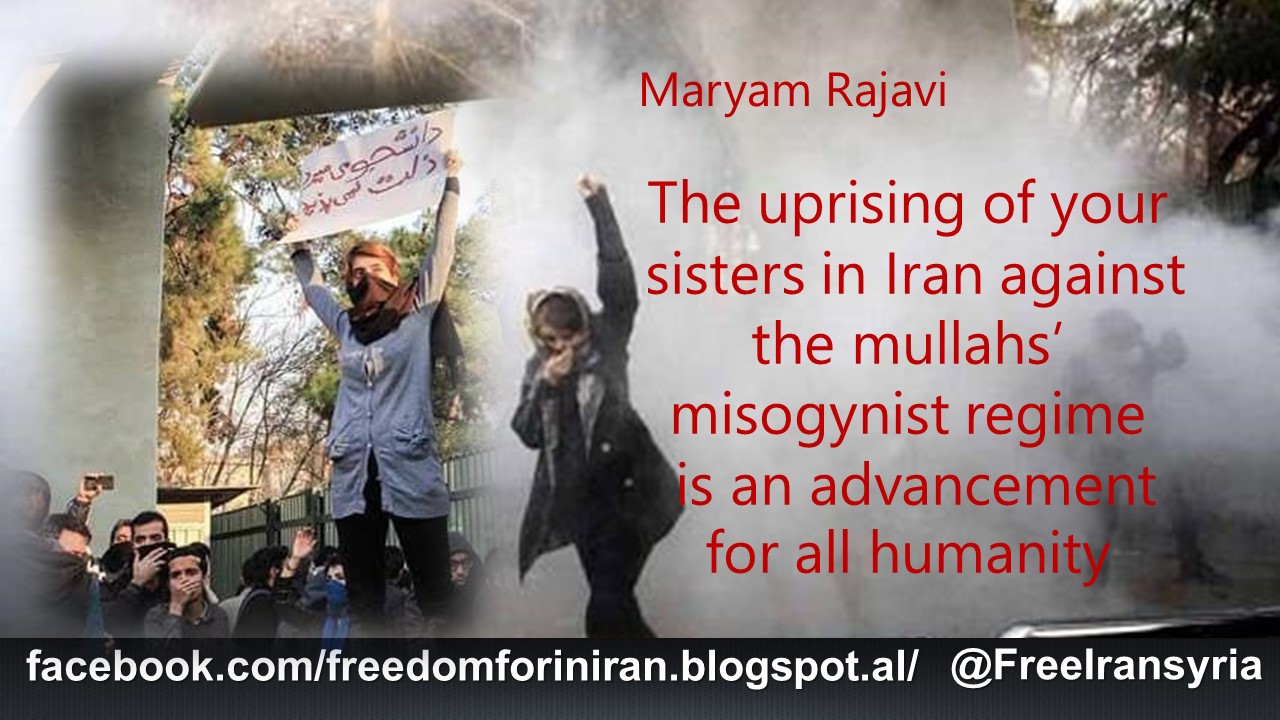
The uprising of your sisters in Iran against the mullahs’ misogynist regime is an advancement for all humanity. 
Any step you take for them, any activity in defense of the arrested women, any effort to expose the torture of prisoners, and anything you do to compel your governments to cut ties with the clerical regime, is going to have an impact.

In the present circumstances, we call for the immediate release of the prisoners of the uprising, freedom of expression and assembly, and abolition of women’s suppression and the compulsory veil.

To realize these objectives, we need the support of each and every one of you.
The day when the women of Iran destroy the roots of fundamentalism in Iran, freedom and equality will make a leap forward all across the world. And that day is not far. 
I thank you all.

 MARYAM RAJAVI’S MESSAGE TO WOMEN’S CONFERENCE AT THE UK PARLIAMENT

 Maryam Rajavi Calls on U.N. for Urgent Action to Secure Release of Detainees in the Nationwide Uprising

Opening fire on demonstrators, mass arrests, and torture to death are examples of crime against humanity

Mrs. Maryam Rajavi, President-elect of the National Council of Resistance of Iran, called on the UN Secretary General, Security Council, member states and High Commissioner on Human Rights as well as other relevant international organizations to take urgent actions to have those arrested during the Iranian people’s nationwide uprising immediately released and determine the statuses of the disappeared.

Opening fire on demonstrators, mass arrests, and torturing prisoners to death – as practiced these days by the clerical regime’s henchmen in various Iranian cities – are indisputable examples of crime against humanity and demand urgent action by the international community. Maintaining silence over these crimes emboldens the religious fascism ruling Iran in continuing its crimes.

In the first two weeks of the nationwide uprising of the people of Iran, at least 8000 protesters were arrested by the Revolutionary Guards (IRGC) and suppressive forces. A large number of them have disappeared and there is no news available on them. 90 per cent of those arrested are under 25 years of age and 35 per cent of them are high school students. A number of these prisoners have been killed under torture in Tehran and other cities including Arak, Sanandaj and Zanjan.

Secretariat of the National Council of Resistance of Iran January 18, 2018


Maryam Rajavi's Response to the Iranian Protests

The president-elect of the Iranian Resistance has written a powerful piece for the Wall Street Journal explaining why the current wave of protests in Iran are completely different from the 2009 protests about the rigged re-election of Mahmoud Ahmadinejad.

Maryam Rajavi, the leader of Iranian opposition coalition the National Council of Resistance of Iran (NCRI), wrote: “Then, the cause was a rift within the regime. Now, the people are demanding an end to the regime.”

The current protests, which began over a sharp increase in the cost of living in late December, have turned into widespread demonstrations for the end of the corrupt clerical regime and spread far further than the 2009 protests ever did and show the international community that the Regime is on borrowed time.

Maryam Rajavi explained: “The clerical regime stands on shaky ground, and the Iranian people are unwavering in their quest to bring it down. Slogans against velayat-e faqih, or absolute clerical rule, called for a real republic and explicitly targeted the regime’s Supreme Leader Ali Khamenei and President Hassan Rouhani. This dispels the myth, still harboured by some governments that Iranians distinguish between moderates and hard-liners in Tehran. It also undercuts flawed arguments depicting a stable regime.”
Economy
Millions of Iranians live in poverty but the Regime is doing nothing to help. Instead, they are spending $100 billion to prop up the Syrian Regime and support terrorist groups like Hezbollah and Hamas instead.

The regime’s latest budget allocates over $26.8 billion to military and security affairs and the export of terrorism in addition to the $27.5 billion in military spending from institutions controlled by Khamenei and the Islamic Revolutionary Guard Corps (IRGC). By comparison, the healthcare budget is just $16.3 billion.

Maryam Rajavi wrote: “Weak and vulnerable, the regime spends such astronomical sums on regional meddling as part of its strategy for survival.”

The Iranian protesters have been chanting “Death to Hezbollah” and “Leave Syria, think about us instead”, proving that they oppose the Regime’s deadly destruction of the Middle East, especially at the expense of their own people.
It is also worth noting that the Regime’s corruption is widespread and well known. That is why there are no illusions of internal reform from the protesters; simply, the Regime must go.

Maryam Rajavi wrote: “This systemic economic mismanagement has its roots in the political system, and it grows worse every day. That is why the demand for regime change surfaced almost immediately. It seems to be the only conceivable outcome.”

Much bigger than 2009

Not only are the current protests much wider spread geographically, they are also much wider spread in terms of demographics. Rather than being made up of mainly middle and upper-class Iranians, these ones are made up of people from every class, ethnicity, religion, and gender.

Maryam Rajavi wrote: “The recent demonstrations span a much broader swath of the population—the middle class, the underprivileged, workers, students, women and young people. Nearly all of society has been represented on the picket line.”

Iran Protest-MaryamRajavi’s messages
MARYAM RAJAVI’S MESSAGE TO THE IRANIANS’ RALLY IN WASHINGTON, D.C. TO SUPPORT IRAN UPRISING
The part of the Message:
1.To recognize the Iranian people’s legitimate right to topple the ruling religious fascism and establish freedom and popular sovereignty;
2.To vehemently condemn and hold the Iranian regime accountable for the slaughter and mass arrests of unarmed, defenseless protesters;
3.To censure disruption of access to internet services and social media and guarantee free access for the general Iranian public to the internet;
4.To sanction the clerical regime for its systematic human rights abuses in Iran, including the massacre in 1988, and the slaughter of participants in the present uprising.
Dear friends, fellow compatriots,
The ongoing uprising in my enchained homeland is a quest for freedom, democracy and equality. It is a movement for social justice; and it is a movement which will carry on until final victory. 
Iran Protest-MaryamRajavi’s messages
Maryam Rajavi: Iranian Protesters Turned the Page on the UN and Security Council’s History on Iran
Maryam Rajavi: Iranian Protesters Turned the Page on the UN and Security Council’s History on Iran
If you persist, the world will stand with you and on your side.
Ending the silence on Iran and shattering a 4-decade-old barrier of appeasement of the regime, the UN Security Council’s meeting on Iran is a product of the Iranian people’s uprising, the sacrifice of its martyrs and the suffering of its captives. The world’s major governments had so far turned a blind eye on brutal suppression of our people and executions of 120,000. Iran’s protesters and youths, however, have in their first step turned the page of the United Nations and Security Council’s history on Iran. This indicates that the young men and women who rose up in the streets of Izeh, Doroud, Tuyserkan, Ghahdarijan, Jouyabad of Isfahan, and 75 other cities can and must turn the darkest page of Iran’s history. 
As the Iranian Resistance’s Leader, Massoud Rajavi, said, “If you persist, the world will stand with you and on your side.”

Maryam Rajavi:
Maryam Rajavi:I Urge My Compatriots to Join the Nationwide Quest for Freedom
Thousands of salutes to those martyred in Doroud, Tuyserkan, Noorabad, Izeh, Shahinshahr, Ghahdarijan, Homayounshahr and Jouyabad of Isfahan!
Fellow protesters!
Courageous sons and daughters of Iran!
You have brightened up Iran’s cities with the light of struggle for freedom and justice.
Well done! You have shaken the ground under the feet of the mullahs’ rotted regime.
Thousands of salutes to those martyred in Doroud, Tuyserkan, Noorabad, Izeh, Shahinshahr, Ghahdarijan, Homayounshahr and Jouyabad of Isfahan!
You have brought the nation closer to her dreams of 100 years.
You have proven that it is possible to liberate Iran from the yoke of religious dictatorship and theocracy. 
The nations of the Middle East, from Syria to Iraq and Afghanistan, those who have suffered tremendously because of the mullahs’ oppression and their theocratic regime, are praying for your victory. 
The world’s freedom lovers have vested their hopes in you, and the world has heard your voice.
Governments and international organizations have come out one after the other to support and praise you. 
The nation’s martyrs, including the heroes and heroines of the 80s, the political prisoners massacred in 1988, the martyrs of 2009 and the martyrs of Ashraf, have set their sights on you.
You are the children of Sattar Khan , Dr. Mohammad Mossadeq, and Mohammad Hanifnejad . 
And your uprising will revive all of Iran’s honors.
Today, Khamenei and his cohorts take resort in threatening you.
They trumpet their criminal record. 
They mobilize their military forces to counter the Iranian people’s nationwide uprising. 
Their so-called reformist and moderate proxies who have stopped at nothing to provide services to the mullahs’ religious fascism, have now removed their masks and called for suppression of freedom-loving people. 
They grab at any straw to prevent throngs of people from joining your ranks. 
Behind such threats, however, the regime is twisting and turning out of enormous fear.
Despite its hollow show of force, the clerical regime is just a paper tiger and will not withstand your uprising. 
Because you are the decisive power.
You are countless and your numbers grow every day. 
When you get sincerely united and join hands, your solid resolve will overcome any power.
The mullahs think they can contain your upheaval and stop its expansion by blocking the internet services and social media. But they do not know and cannot understand that it is your common pain and suffering that bonds your hearts and spreads the message everywhere. And this is how the cities rise up one after the other. 
I call on all my fellow compatriots to rise up and join the roaring tide of freedom lovers across the country. 
Maryam Rajavi:
My fellow countrymen in Baluchistan, Kurdistan, Azerbaijan and Lorestan,
My dear Bakhtiari, Turkoman and Ghashghaii compatriots, 
Fellow Sunni countrymen, 
Fellow countrymen who inhabit in villages, suburbs and shanty towns across the country, 
This uprising is yours and it is for you.
Your children have risen up and engaged in a decisive battle to turn the darkest page of Iran’s history. Rise to their aid!
Fellow compatriots, my dear sisters and brothers, 
Do not abandon the protesters, and the army of deprived and plundered people. Do not leave them alone in the streets. Now is the time for workers, farmers, Bazaar merchants, government employees, teachers, physicians, nurses, university professors, and all social sectors to support them. This is an uprising that belongs to the freedom-loving but enchained people of Iran.
Do not lose any opportunity to support and join the courageous women and men who fight on the streets and risk the dangers. 
Stage sit-ins and strikes anywhere you can, in the factories and offices and at every work place, so that the world will see the general public's protest against the mullahs' detested rule in Iran and hear our nation's voice. 
As Massoud Rajavi said, “Iran and its enchained people have risen up and the dawn is near.” 
His messages, these days, are the best and clearest practical guidelines.
The uprising you launched, is an uprising for freedom, democracy, equality, and separation of religion and state;
This is an uprising for social justice;
And this is a movement that will carry on until final victory.
God bless you,
Long live freedom!
Maryam Rajavi:
Maryam Rajvi's Call for Uprising and Fearful Admission of Iran Regime's Official to PMOI/MEK's Leading Role
On Monday January 1, 2017. Mohammad Ali Asoudi, the senior consultant to Khamenei’s representative in the Revolutionary Guards Corps (IRGC), in an interview with the state run ‘Daneshjou’ press agency stated:
“Concerning the recent unrest and events in some cities in the country… those who have rightful demands, should not take to streets, since these rallies are being abused and some insurgents destroy the public property!”
The Senior IRGC commander further added: “regarding the presence of the members and affiliates of the People’s Mojahedin Organization of Iran in these riots, it is notable that when Maryam Rajavi officially sends a message and calls everyone to take into scene, it is evident that they (PMOI/MEK) members and supporters are in the front row.

Fox News: In Iran, 'death to the dictator!' Anti-regime street protests grow, demanding democracy and freedom Fox News- 30 December 2017
Fox News: In Iran, 'death to the dictator!' Anti-regime street protests grow, demanding democracy and freedom Fox News- 30 December 2017
Rajavi’s statement said Iranian’s have loudly rejected the mullah’s regime
Estimates say that up to one million Iranians have been protesting across the country since Thursday in what one Iranian opposition group says has turned into a protest for regime change.
Those protesters are being buoyed by messages from the Trump administration, says the National Council of Resistance of Iran (NCRI), a coalition of democratic Iranian groups and personalities...
Maryam Rajavi: Messages on second day of  No to High Prices"- Uprising, :

Iran Protest-MaryamRajavi’s messages
Maryam Rajavi:  Uprisings of Kermanshah

Follow Freedom for Iran on:

https://plus.google.com/u/0/115000766128351373575

https://www.facebook.com/freedomforiniran.blogspot.al/?
ref=settings

Freedom4Iran
@FreeIransyria