Instead of freeing Nazanin Zaghari-Ratcliffe at Christmas, Iran upheld its death sentence for another prisoner
The Islamic Republic’s status as a pariah state must be restored – a boycott by travellers on human rights grounds could kick-start wider sanctions and a rethink on the nuclear deal
“We are sitting by the phone hoping,” Richard Ratcliffe said over the weekend – the hope was that his wife, Nazanin, a charity worker imprisoned since April 2016 by the Iranian government, might be released by Christmas Day.
Unsurprisingly, instead of going all mushy and Christmassy, the Islamic Republic stayed true to form – immoral, ruthless and uncompromising.
The Supreme Leader was never going to change his cloaks for a Santa outfit, filling stockings with freedom and long-denied human rights. Read more
Call for the Abolition of the Criminal Execution Order of Ahmad Reza Jalali
Iranian Resistance strongly condemns the death sentence for Dr. Ahmad Reza Jalali and calls on all international human rights advocates to take immediate and effective action to abolish this cruel sentence.
Mr. Jalali, a resident of Sweden, was arrested on April 24, 2016, and was sentenced to death by the Iranian regime’s courts in September 2017. Only a few days later, the Supreme Court of the mullahs’ approved the verdict. Throughout this process, he has been deprived of a fair trial, even within the framework of the human rights law of the mullahs’ regime, including the right to appeal. Read more
UN rights experts call on Iran to annul death sentence against academic and free him
GENEVA (20 December 2017) – United Nations human rights experts* have appealed to Iran to annul the death sentence against an Iranian academic, saying they are deeply “disturbed” by ongoing reports of due process failings during his trial.
Doctor Ahmadreza Djalali, an Iranian national and resident of Sweden, is a medical doctor, lecturer and researcher in disaster medicine who was arrested in April 2016. The procedure against him was marred by numerous reports of due process and fair trial violations, including incommunicado detention, denial of access to a lawyer, and forced confession.
“The execution of Dr. Djalali must be immediately halted and he must be released and accorded an enforceable right to compensation and other reparations,” the experts said.
“No formal charges were brought against him for nearly 10 months and he was effectively prevented from exercising his right to challenge the legality of detention. Furthermore, Dr. Djalali’s rights to a fair trial before an independent and impartial tribunal and to an effective defence have been violated.”
During Dr. Djalali’s detention, he was reportedly threatened with torture and other forms of ill-treatment, and threatened with being sentenced to death through an expedited process. Following this he was allegedly forced to confess to certain crimes, and forced to repeat dictated statements before video cameras. REAAD MORE
The Iranian Supreme Court upheld the death sentence of Iranian researcher Ahmad Reza Jalali despite widespread international opposition.
Dabir Darya Beigi, Jalali’s lawyer, received the verdict for the death sentence on Sunday December 10., according to the human-rights group Amnesty International.
“The current situation is awful. It would be great if the scientific community would speak on this issue and issues facing Iranian scientists,” says molecular biologist Richard Roberts at New England Biolabs in Ipswich, Massachusetts, who won the 1993 Nobel Prize in Physiology or Medicine. Roberts is one of 79 Nobel laureates who last month signed a letter protesting against the sentence.
“Scientists should call en masse Iranian diplomatic missions in their countries and voice their concern about the fate of Ahmadreza Djalali,” says Eugene Chudnovsky, a physicist at the City University of New York who co-chairs the Committee of Concerned Scientists, a human-rights body based in New York City. Read more Iran: Upholding academic’s death sentence in secret shows utter contempt for right to life
The Iranian Supreme Court has run roughshod over the rule of law by upholding the death sentence of Ahmadreza Djalali, an Iranian-born Swedish resident and specialist in emergency medicine, through a secret and hasty process and without allowing any defence submission, Amnesty International revealed today.
Ahmadreza Djalali’s lawyers learned on Saturday 9 December that Branch 1 of the Supreme Court had considered and upheld his death sentence in a summary manner without granting them an opportunity to file their defense submissions. Read more
Please sign, share, the petition to #SaveAhmad 75 Nobel Laureates call on Iran to release scientist and medical doctor Ahmadreza Djalali, who has been sentenced to death in Iran for "spreading corruption on earth"
Ambassador Gholamali Khoshroo
Mission of Iran to the United Nations
622 Third Ave., 34th Floor
New York, NY 10017
Re: Plea for Ahmadreza Djalali
Dear Ambassador Khoshroo:
As members of a group of people (and organizations) who, according to the will of Alfred Nobel are
deeply committed to the greatest benefit to mankind, we cannot stay silent, when the life and work of a similarly devoted researcher as Iranian disaster medicine scholar Ahmadreza Djalali is threatened by a death sentence.
According to reports by the international weekly journal of science Nature (23 October 2017)
https://www.nature.com/news/iranian-scholar-sentenced-to-death-1.22875
and other sources, Ahmadreza Djalali was accused of collaboration with a hostile government and
sentenced to death on 20 October.
Dr. Djalali, a resident of Sweden with his family, works on improving emergency responses of hospitals to
armed terrorism and radioactive, chemical and biological threats. Dr. Djalali is affiliated with the
Karolinska Institute in Stockholm, Sweden, and the University of Eastern Piedmont in Novara, Italy. He was arrested in April 2016 on an academic visit to Tehran.
While the conditions of his detention and trial have already given reason to great concern, a document based on a handwritten text by Dr. Djalali has now raised the suspicion that it was his refusal to work for the Iranian Intelligence Services, which led to this unfair, flawed trial.
Thus, we join in the several existing petitions:
https://www.change.org/p/hassan-rouhani-urgent-justice-and-f
A distinguished expert in disaster medicine was sentenced to death by the Iranian Regime last month, after he refused to spy for them.
Dr. Ahmadreza Djalali, a resident of Sweden, was sentenced by the Iranian Revolutionary Court on October 21 after being found ‘guilty’ of providing evidence about Iran’s secret nuclear sites to the Israeli intelligence agency Mossad, which led to the assassination of Iranian nuclear scientists in 2010-2012.
Of course, the Iranian Regime routinely accuses people of spying for the US and Israel, which it calls the Big Satan and the Little Satan respectively, with no actual evidence. Read more
Prominent academic sentenced to death after grossly unfair trial
rominent academic sentenced to death after grossly unfair trial
Amnesty International – 23 October 2017
The Iranian authorities must urgently quash the death sentence against Iranian-born Swedish resident and specialist in emergency medicine Ahmadreza Djalali, said Amnesty International today.
The medical doctor and university lecturer had studied and taught in Sweden, Italy and Belgium. Since his arrest in April 2016, several European officials have called for his release.
Zeynab Taheri, one of Ahmadreza Djalali’s lawyers, told Amnesty International that he was sentenced to death for the charge of “corruption on earth” (ifsad fil-arz), and has been given a 200,000 euro fine. The court verdict, which was shown to one of the lawyers, states that Ahmadreza Djalali worked with the Israeli government, who subsequently helped him obtain his residency permit in Sweden.
“Ahmadreza Djalali was sentenced to death after a grossly unfair trial that once again exposes not only the Iranian authorities’ steadfast commitment to use of the death penalty but their utter contempt for the rule of law,” said Philip Luther, Amnesty International’s Research and Advocacy Director for the Middle East and North Africa.
“No evidence has ever been presented to show that he is anything other than an academic peacefully pursuing his profession. If he has been convicted and sentenced for peacefully exercising his rights to freedom of expression, association and assembly, including through his academic work, the authorities must immediately and unconditionally release him and drop all charges against him.” Read more Follow Freedom for Iran on:
Thousands of death row and political prisoners call for the abolishment of executions in Iran
In a conference on the occasion of the World Day Against Death Penalty, held in the municipality of the 5th arrondissement of Paris, a call for the abolishment of executions in Iran was read.
The signatories included 2,320 prisoners on death row from nine cities of Iran, political prisoners as well as the families and relatives of the inmates.
Behzad Naziri, a member of the Foreign Affairs Commission of the National Council of Resistance of Iran, who read out the statement at the conference, told the audience, “I want to draw your attention to news that has been coming out of the prisoner of Iran. Since September 23, The Iranian resistance has been engaged in a widespread campaign regarding executions in Iran.
On Wednesday, October 10, 2018, the Mayor of the 5th District in Paris hosted a conference against the death penalty in Iran, organized by the Committee for the Support of Human Rights in Iran (CSDHI).
Several mayors, politicians, and celebrities spoke at this conference marking the World Day Against the Death Penalty.
On the 16th World Day Against the Death Penalty, Gérard Deprez, Member of European Parliament and Chair of Friends of a Free Iran, issues a statement, in which he expressed “deep concern over the executions in the Islamic Republic of Iran.” Friends of a Free Iran (FoFI) is an informal group in the European Parliament which was formed in 2003 and enjoys the support of many MEPs from various political groups.
“Iran at the moment has the highest number of executions in the world per capita,” Deprez warns, adding that according to Amnesty International, more than half of all recorded executions in the world in 2017 took place in Iran.
MARYAM RAJAVI’S MESSAGE TO THE “NO TO EXECUTIONS AND TERRORISM” CONFERENCE HELD AT DISTRICT 5 MUNICIPALITY IN PARIS
On the World Day against the Death Penalty, Maryam Rajavi addressed a message to the participants in a conference at the District 5 Municipality of Paris. Following is the full text of her remarks:
The World Day Against the Death Penalty is to promote a universal value to defend the sanctity of human life. At the same time, it points the finger at the mullahs’ theocratic regime for being the world’s top record holder of executions and for relying on massacres.
Let us salute the 120,000 valiant children of Iran, including the political prisoners massacred in 1988, who were executed by the regime for fighting for freedom.
Their deaths are an everlasting disgrace for the mullahs who have built the pillars of their rule on blood. They are devoid of any popular, humanitarian, or historic legitimacy, and the overthrow of their regime is the urgent objective of the nationalist struggles of the Iranian people and Resistance. A goal which will most certainly be realized beyond a shadow of a doubt. Read more
The nonstop cycle of executions is aimed at preserving the mullahs’ religious tyranny
The World Day against the Death Penalty is a time to pay tribute to 120,000 PMOI and combatant freedom-fighters including the 30,000 who were hanged during the 1988 massacre by the religious dictatorship in Iran.
It is also a day to reject the mullahs’ abhorrent regime who protect their decadent rule by daily executions in the face of public dissatisfaction and protests of a restless society that thirsts for freedom.
As Amnesty International has reported, with the exclusion of China, the Iranian regime accounts for 55 per cent of the total number of executions in the world. Therefore, the World Day against the Death Penalty is a day when the world says no to the mullahs’ religious tyranny.
What distinguishes the executions in Iran from those carried out in other parts of the world, are not the number of executions but their systematic trend. One of the pillars of the clerical regime’s rule are executions in which all of the regime’s factions collaborate. Under whatever pretext or charge, the mullahs’ intention in carrying out the executions is to preserve and escalate repression and general terror. In fact, the government’s killing machine is at work day and night. They increase and decrease the number of hangings upon Khamenei’s order and depending on domestic and international political situation. They take advantage of these killings to balance the defeats and disabilities of the ruling power, or counter the spirit of protests in society.
For this reason, international bodies have time and again confirmed that the orders for many of these hangings have been issued first for crimes that were either vague or were not considered “very serious crimes” from the standpoint of “international standards.”
Secondly, the victims of executions are deprived of their rights to a fair trial and due process of law. Before anything else, they are victims of organized crimes whose continuation is the regime’s daily need.
As the UN rapporteur on human rights in Iran has stated, “Many of those executed are poor and belong to marginalized groups in Iranian society.”
As in the anti-patriotic war with Iraq where Khomeini used young men and teenagers as cannon fodder and disposable soldiers, the ruling mullahs are now imposing an agonizing poverty on the Iranian people driving many towards depravity and corruption. In the meantime, they hang the victims of those wrongdoings and crimes in the nonstop cycle of hangings and executions. With utmost cruelty, they do not even spare the mentally disabled and those who committed crime as a minor. In addition, an endless line of thousands of unfortunate prisoners is on the death row.
This is while the children of the regime’s officials who commit much worse crimes including astronomical embezzlements and theft are immune from any form of punishment. More importantly, the Islamic Revolutionary Guard Corps and the ruling mullahs hold the strings that control many of the crimes for which the poor are executed, including drug trafficking and prostitution.
Fortunately, the opposition to the mullahs’ criminal regime is growing every day among the populace and the families of prisoners and execution victims have repeatedly staged protests outside the regime’s prisons and other centers in protest to the execution of their children and relatives.
The Iranian Resistance espouses the abolition of the death penalty in Iran after the overthrow of the clerical regime and rejects the inhuman punishment of retribution as it is diametrically opposed to the spirit of clemency and compassion of the Mohammadan Islam.
Once again, I call on Western governments to make their commercial and diplomatic relations with the religious dictatorship ruling Iran, contingent on the end to torture and executions.
I urge the United Nations to set up a committee to investigate the 1988 massacre in Iran and hold accountable its masterminds and perpetrators who remain in charge of executions carried out today in Iran.
The prosecution of the masterminds and perpetrators of the 1988 massacre has turned into a general desire in the Iranian society, more than ever before. The Call for Justice Campaign is an indispensable part of the efforts to end the wave of executions in Iran.
I call on my fellow compatriots, particularly the Iranian youths, to stand up to the policy of execution and slaughter. The campaign against the death penalty is part and parcel with the campaign seeking to overthrow the clerical regime and rid the people of Iran from the mullahs’ atrocious rule.
Maryam Rajavi Calls for International Commission of Inquiry to Prosecute Perpetrators of The Horrendous Crime of the Massacre of 30,000 Pol. Prisoners The 29th anniversary of the massacre of 30,000 political prisoners in Iran was observed during a ceremony held in the presence of Mrs. Maryam Rajavi, the Iranian Resistance’s President-elect, political and human rights dignitaries from the US and Europe, and a large number of PMOI members in Tirana, capital of Albania.Maryam Rajavi acknowledged in her remarks to the expansion of the movement calling for justice for the victims of the 1988 massacre among Iranians as well as human rights advocates from around the world. She urged the UN Human Rights Council and the UN High Commissioner for Human Rights to launch an international commission of inquiry to investigate this horrendous crime. She called on the UN Security Council to refer this dossier to the International Criminal Court or a special court to prosecute the perpetrators of this crime against humanity, criminals who are presently among the leaders of the clerical regime.
Maryam Rajavi’s speech on the anniversary of 1988 massacre of political prisoners
The conspiracy of silence is shattered
Dear sisters and brothers, honorable friends,
The Campaign Calling for Justice for the Victims of the 1988 Massacre has expanded over the past year both in Iran and abroad. In response, the clerical regime undertook enormous effort to neutralize this movement. But it has failed miserably.
The mullahs were forced to retreat from their policy of hiding the 1988 massacre. The conspiracy of silence was shattered. The regime’s officials tried to justify this horrendous crime but they could not convince even many of their own clerics to defend the fatwa issued by Khomeini.
Indeed, the prospect of the regime’s overthrow stymied the regime’s supporters and allies. In contrast, many spoke out in defense of the PMOI/MEK. Many opened their eyes and saw the righteousness of the PMOI’s path and ideal such that throughout the past year, the mullahs repeatedly said and wrote that the PMOI/MEK had been vindicated in society.
This was yet another major defeat for the mullahs’ theocratic regime.
After the sham presidential election, when offering an assessment of the state of the regime, Supreme Leader Ali Khamenei’s said the place of victims and executioners had been switched.
Yes, we managed to overcome the regime’s official propaganda.
Everyone saw that Khamenei had made a major political investment in Ebrahim Raisi, a member of the Death Commission in the 1988 massacre, to become president. But he was defeated by the Call for Justice movement.
The 1988 massacre is the hallmark of the mullahs’ religious dictatorship. In his first term, Hassan Rouhani appointed Mostafa Pour Mohammadi, a member of the Death Commission, as his Justice Minister. Now, in his second term, he has nominated as Minister of Justice another perpetrator of the massacre in Khuzistan Province. The European Union has already designated and sanctioned this man, Alireza Avayi, for being directly involved in violations of human rights. In reality, none of the regime’s factions can or want to distance themselves from this crime.
For this reason, in the past year, a number of the regime’s most disgraced murderers tried to justify the massacre in the face of the Call for Justice movement. These admissions are among the most important documents incriminating the regime’s leaders. They once again proved that it is the Iranian people’s inalienable right to overthrow the regime.
That you have compelled them to make such admissions represents one of the achievements of the Call for Justice movement over the past year. These confessions are particularly important because they have been made recently and can therefore provide a solid basis for an international commission of inquiry into the 1988 massacre.
At the same time, it is essential that the UN Security Council refer this case to the International Criminal Court to arrange for the prosecution of the regime’s leaders and those responsible for the massacre.
How the international community approaches this genocide and this crime against humanity is a litmus test of its adherence to the principles of human rights. As Massoud Rajavi said years ago, the prosecution and punishment of the perpetrators and masterminds of the 1988 massacre are the inalienable rights of human society, the people of Iran, and the PMOI/MEK.
Owing to the valuable year-round activities of the Resistance’s network inside Iran, today, we have ample evidence and documents. They include many names of the victims, the names of 112members of the Death Commission in Tehran and other provinces, nearly all of whom hold key positions in the regime. We also have the names and particulars of 213 criminals who carried out the death decrees in 35 cities as well as the information about the locations of several mass graves that had been previously hidden.
A precious achievement to offer to the Iranian people and all activists of the Call for Justice Movement.
Human rights, in particular, bringing to justice the officials involved in the 1988 massacre, should be at the core of Iran policy
Human rights defenders, dignitaries, European politicians and the Iranian Resistance called for the formation of an international commission of inquiry into the massacre of political prisoners in Iran in the summer of 1988 and bringing those responsible for this genocide and crime against humanity to justice. Read more
SPEECH BY STRUAN STEVENSON
The Paris District 1 exhibition and meeting on August 17, 2017, commemorated the anniversary of the 1988 massacre of political prisoners and censured continuation of mass executions in Iran.
In an address to this meeting at the Paris District 1 City Hall, Struan Stevenson, Former European lawmaker and President of the Friends of Free Iran Intergroup called for a full United Nations inquiry into the 1988 massacre, with Khamenei, Rouhani and their claque of killer clerics indicted for crimes against humanity and brought for trial before the international courts in The Hague Click here to read for full text of the speech
MESSAGE BY MARYAM RAJAVI TO PARTICIPANTS IN THE PARIS 1ST DISTRICT EXHIBITION ON THE MASSACRE OF 30,000 POLITICAL PRISONERS IN IRAN
Since the inception of their rule 38 years ago, the mullahs’ demands can be summarized in the following sentences:
Here you are; this is our market and here is our oil and gas. Just when it gets to human rights and freedom of the people of Iran, turn your head away.
This is how they hanged our 30,000 political prisoners in Iran in days such as these in summer 1988, without any reactions by Western governments.
Those who remained silent over this tragedy, betrayed humanity because the mullahs found out that their crimes had no consequences. So, they continued by exporting their terrorism and fundamentalism abroad and drenching the Middle East in blood.
If in those days, the massacre had not been met with silence, today, the mullahs could not sink Syria in a whirlpool of blood.
Fortunately, the movement calling for justice for the victims of the massacre in Iran has expanded since last year. Today, even youths born after the massacre have risen up to call for justice for the victims.
The people of Iran want to end the impunity of those in charge of the massacre and hold them accountable. This has turned into the Iranian people’s most important political demand from the clerical regime.
The campaign calling for justice obtained new information about the slaughter, including a large number of names of the victims, as well as the locations of numerous mass graves which the mullahs had previously concealed. The people of Iran demand that the perpetrators of the massacre be held accountable and their impunity ended.
The Justice seeking movement in Iran managed to corner the mullahs.
Khamenei intended to put a member of the 1988 massacre’s Death Commission in the office of president, but the nationwide campaign calling for justice foiled his plans.
Nevertheless, the mullahs from either faction cannot and do not want to distance themselves from the massacre.
Over the past four years, the mullahs’ president Hassan Rouhani had appointed Mostafa Pour Mohammadi, one of the key officials in charge of the 1988 massacre, as Minister of Justice. He has now decided to appoint a new Justice Minister for his second term, but the new minister, too, is another one of the perpetrators of the massacre, by the name of Avaii who has been already designated as a violator of human rights by the European Union. Read the Text of the massage
Ms. Shahin Mahinfar posted a letter on October 13, 2016, saying that she could watch the video clip of how his son got killed for the first time after seven years. Following is the text click here
In another post she wrote: it’s Time for the Tyrants to Cry
Iranian women and activist mothers who have lost their children under the mullahs' oppressive regime in Iran, spoke out against the executions in Iran on the World Day against the Death Penalty.
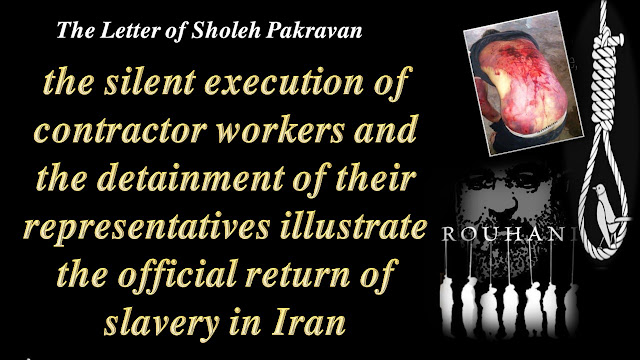
In a post on her Facebook, the anti-Death Penalty activist Sholeh Pakravan wrote, "No to executions, long live freedom. October 10 is a special day, the World Day against the Death Penalty. Because of the highest number of executions in our country, every day can be called a day to protest this naked violence. When we see bloodied (trace of noose around the) necks of those executed, we must protest and ask why? The world must also intervene. Combatting executions must have priority over any talk. It must be pre-condition to every deal. To combat the death penalty, we need national determination. The people of Iran must unite their voices and say: Executions are enough. No to executions. Long live freedom."
Ms. Shahin Mahinfar, mother of Amir-Arshad Tajmir who was killed by revolutionary guards in the 2009 uprising, also wrote, "Execution is a medieval sentence which is not appropriate for human beings. Our nation that has suffered loss many of her youths, cries out in one voice: No to executions; No to executions; No to executions."
UN Must Act Against Iran Regime for Its Role in 1988 Massacre
Juan E. Garcés, the Spanish lawyer who brought a case against Chilean General Augusto Pinochet for his war crimes under the principles of universal jurisdiction, wrote: “It is my hope that newfound attention for the 1988 massacre and the subsequent crimes of Iran’s political/religious system will help to reiterate the message that was previously sent by my colleagues and me through our prosecution of the Pinochet crimes. The essence of that message is that, while some officers may enjoy impunity as they commit human rights violations and misuse the instruments of the state, this impunity need not continue forever, much less be accepted by human rights advocates and foreign observers who have the legal mandate to investigate such crimes.”
Throughout the world, many leaders have failed to act against human rights abusers, which has led to continued and worsening human rights abuses.
Consultative Counsel of Human Rights member speaks out against 1988 massacre in Iran
Merinews- 15 Feb 2018- On February 1, a Civil Society hearing was held in Geneva, with the purpose of drawing attention to not only the massacre in 1988 of 30,000 political prisoners, but also to draw attention to the actions of the Iranian regime against those involved in the latest protests.
Concern for the well-being of those protesters who have been taken into custody is mounting among NGOs and other international leaders, many of whom can point to the previous violent actions of the regime throughout its nearly forty years in power.
One of the key speakers was Professor Jean Ziegler, who is a member of the Consultative Committee of the Council for Human Rights, which is a subsidiary organ of the Council for Human Rights in the United Nations .
he Vice-President of the Advisory Committee to the United Nations Human Rights Council has said that a commission of enquiry into the 1988 massacre in Iran needs to be set up. Jean Ziegler said that a special tribunal needs to be established so that Iran’s impunity with regards to this crime against humanity is put to an end. His comments came during a civil society hearing in Geneva on 1st February in Geneva.
Witnesses and experts spoke at the hearing and presented testimonies, statements and advice. They said that it is up to the United Nations to intervene and take action so that Iran’s impunity does not continue any longer. As well as Iran’s impunity with regards to the horrific 1988 massacre, the Iranian regime is still continuing to commit other crimes against humanity. The speakers mentioned in particular the current wave of arrests and torturing to death of protesters in jail in the aftermath of the widespread protests and anti-government demonstrations that started at the end of December last year.
He said that his committee has been called, on numerous occasions, to act following the crimes committed by the regime in Iran for the past 39 years. He said that the hearing was to remember and commemorate the 33,000 Iranians that lost their lives during the 1988 massacre. He said that they were also gathered on this day to discuss how to put an end to the impunity that it is still benefiting from. He wants to bring the regime to justice and described its impunity as "scandalous".
He offered his condolences to the families of those who died in 1988, to the survivors of the massacre and to all those that have been victims of the Iranian regime over the years.
Ziegler indicated that the situation in Iran has changed because the people have spoken out again in a popular uprising. He also pointed to the young people of Iran - a new generation - that has bravely risked their lives, torture and arrest to speak out against the rising prices, against the economic misery and against the corruption of the mullahs. What has sparked their discontent is the injustice of the 1988 massacre. The people are calling for freedom, democracy, respect of human rights, and they are spurred on by the heroic example of the 1988 martyrs.
Ziegler spoke about Dr. Kazem Rajavi - the renowned human rights advocate that made it his life’s mission to defend human rights in Iran. He was Iran's first Ambassador to the United Nations headquarters in Geneva after the 1979 Iranian Revolution but soon resigned as an act of protest to the terrorist and repressive actions of the Iranian regime. After this, his campaign against the Iranian regime’s executions, torture and arbitrary arrests intensified. Ziegler said it was impossible for him to speak at such an event and omit to mention the bravery of Rajavi who was assassinated by the cruel regime only a few dozen kilometres from Geneva.
Speaking about how the regime's impunity can be put to an end, Ziegler said that the West must mobilise and call for it. It must stop putting commercial and economic motives before human rights.
In order for there to be a commission of inquiry, he explained, those who were involved and responsible for the crime against humanity must be identified - on all three levels. Firstly, those who were members of the so-called death committees that the Supreme Leader set up. Secondly, those that actually carried out the hangings and executions, and finally, those that ordered the mass murders who are still in positions of authority today.
He concluded his speech by saying that the United Nations must ensure that a special tribunal is created so that the regime's impunity ends.
Civil society urges UN to launch fact-finding mission to investigate Iran’s 1988 massacre in order to end impunity and prevent the same fate for detained protesters today
On 1 February 2018, a civil society hearing in Geneva heard witnesses and legal experts and offered an adjudication of the 1988 massacre of political prisoners in Iran. The hearing was the first of its kind by NGOs in Geneva, and it urged immediate action by the United Nations to address the current wave of mass arrests and killings in Iranian jails following the recent anti-government protests.
International civil society and NGOs urged the UN High Commissioner for Human Rights to establish a fact-finding mission to investigate the months-long massacre during which the Islamic Republic of Iran executed an estimated 30,000 political prisoners, mostly activists of the People’s Mojahedin Organization of Iran (PMOI/MEK).
During the Geneva hearing, former UN Judges, senior human rights officials and human rights experts and advocates stressed that such an inquiry, long overdue, is now especially crucial in light of the arrest of thousands of peaceful anti-government protesters at the turn of the year, after which numerous protesters died while in authorities’ custody.
Beginning on December 28, two weeks of nationwide protests sent shock waves through the Iranian regime. Thousands of Iranians have been arrested and upwards of 50 killed, at least 12 of them under torture. Many more are at risk of a similar fate.
Participants in the hearing expressed consensus that the 1988 massacre clearly constitutes a crime against humanity. They stressed that the international community and in particular the UN are obliged to take all necessary measures to end impunity in this case and they warned that failure to hold Tehran accountable has simply emboldened the ruling theocracy to continue its gross human rights violations. According to the indictment presented at the hearing, many of the leading perpetrators of the 1988 massacre remain alive today and even continue to hold positions of prominence in Iranian politics and law.
The indictment was presented by the distinguished British lawyer, Kirsty Brimelow QC. She presented ample evidence establishing that the 1988 massacre constitutes a crime against humanity and referring to the current situation in Iran, particularly, the recent mass arrest and killing of protestors in custody, concluded that the crime against humanity in Iran perpetrated by the same officials continues today.
The day-long event was organized by Justice for Victims of the 1988 Massacre in Iran (JVMI). It was sponsored by four NGOs with Consultative Status at the UN.
The hearing was broken down into four sessions:
The first presented an indictment related to the 1988 massacre. Kirsty Brimelow QC, Chair of the Bar Human Rights Committee of the Bar of England and Wales, made the presentation.
The second session heard opinions from preeminent international human rights experts:
Prof Jean Ziegler, vice president of the Advisory Committee to the United Nations Human Rights Council, said it is high time for the UN to end the impunity for the perpetrators of the 1988 massacre.
Dr Juan Garcés, Chief Lawyer in the Spanish case against General Pinochet, explained that under international law these crimes must be investigated.
Tahar Boumedra, a former UN official on human rights, who has written two books on the 1988 massacre provided a full picture of the 1988 massacre and the failure of the UN to take appropriate action. He called on the UN High Commissioner for Human Rights to set up a fact-finding mission to investigate the crime.
Eric Sottas, former Secretary-General of the World Organization Against Torture (OMCT), also spoke about the need for the international community to investigate the crimes committed in 1988 in Iran.
The third session heard oral testimony from survivors and eye-witnesses to the massacre. Mostafa Naderi, who was incarcerated from 1981 to 1992 for being a supporter of the PMOI and miraculously survived the 1988 massacre recounted the 11 years he spent in prison, including five in solitary confinement.
The presiding panel of adjudicators included Geoffrey Robertson QC, head of Doughty Street Chambers in the UK and former appeal judge at the UN Special Court for Sierra Leone, and Prof Eric David, Professor emeritus of international law at the Université libre de Bruxelles. The adjudicators of the civil society hearing presented their concluding remarks at the final session of the day. Both of them, based on the evidence provided, concluded that the UN has an obligation to investigate the 1988 massacre in Iran.
News Week- 30 Jan. 2018- The United Nations (U.N.) is often criticized for not acting or not intervening promptly to rescue victims of gross violations of human rights. This is an observation I came to register when I was in the field as chief of the U.N. Human Rights Office in Iraq.
This week, I will attend a civil society hearing in Geneva for the purpose of investigating the 1988 massacre of political prisoners in Iran, yet another case where the global body of nations failed to act in a timely manner.
Nearly 30 years after the massacre of as many as 30,000 political prisoners, a group of NGOs are holding a civil society hearing to investigate this atrocity for the first time, next door to the U.N. headquarters in Geneva. Survivors of the massacre, relatives of victims and human rights experts will present testimonies and reflect on the way forward.
LEADING OFFICIALS OF IRANIAN REGIME ADMIT THE MASSACRE OF MEK MEMBERS
Iranian regime massacred over 30,000 political prisoners in summer of 1988, and kept silent about this atrocity for three decades. Most of the victims were members and supports of the main opposition group the People’s Mojahedin Organization of Iran (PMOI/MEK). This year in the presidential election as conservative cleric Ebrahim Raisie, one of the perpetrators of the massacre, was selected as one of the main candidates, the issue surfaced, forcing regime officials, one after another, to confess about the carnage.
Last week in an unprecedented interview, Ali Fallahian, the former Iranian intelligence Minister, revealed the mindset behind the mass execution of summer of 1988. Ali Fallahian, who was called as “the most feared mullah in Iran” by the News Week is wanted by Interpol for his involvement in the AMIA bombing that killed 85 people on July 18, 1994 in Buenos Aires, Argentina.
Political Prisoner Writes a Letter Addressing Iranian Regime's Official's Confessions on Massacre of PMOI Members
NCRI - Pointing to remarks made by Iranian regime’s former Intelligence Minister ‘Ali Fallahian’, who confessed in a recent TV interview to parts of regime’s crimes during the ‘80s including the 1988 massacre, political prisoner ‘Ali Moezzi’ has penned a letter titled ‘inevitable confessions of an executioner’ to Iranian people, saying:
“As pointed out in Fallahian’s interview and also previously stated by Ahmad Khomeini, anyone who supported PMOI in the ‘80s, including minors, adults, teenagers, pregnant women, and those who used to read PMOI papers or even buy them bread, was subject to execution. The fact is, however, that even before there was any speaking of PMOI safe houses or anyone buying them bread, regime had declared war against them, by attacking PMOI’s offices and their gatherings while chanting ‘no party but Hezbollah, no leader but Rouhollah (Khomeini)’.
Those who massacred MEK members should be rewarded, senior Iranian official says
Ahmad Khatami, a member of Iran’s Assembly of Experts Board of Chairs, used the Tehran Friday prayer to express his anger over the ever increasing scope of the 1988 massacre justice movement, and actually called for those involved in the atrocity of executing over 30,000 political prisoners to be awarded medals.
“Then we see some people, in their websites, change the place of martyrs and murders. It was a divine move by [Iranian regime founder Ruhollah Khomeini] to force the [MEK] out of the country. All those who acted based on these orders, they should be rewarded with medals…
By Heshmat AlaviAl Arabiya, 22 July 2017 - Ali Fallahian, Iran’s intelligence minister during the tenure of Rafsanjani’s presidency back in the early 90s, is a name most notoriously known for his role in a series of chain murders across the country that saw the elimination of many dissidents.
Fallahian has recently been heard making shocking revelations in reference to mass executions, especially targeting members and supporter of the Iranian opposition People’s Mojahedin Organization of Iran (PMOI/MEK). Read more
Mr. Mousavi (Tabrizi) who was the Revolution’s general prosecutor used to say that there is no need for trial at all ... it makes no sense that we try them ... Imam repeatedly insisted that you should be careful not to let them go... Imam continuously stressed that you should always be cautious of this matter ... Their ruling is always execution. This was his (Khomeini’s) verdict as the supreme leader, both before and after this event of 1988 (massacre of political prisoners).”
Fallahian's remarks are made while the new revelations regarding the massacre of 30,000 political prisoners in the summer of 1988 and the ensued Justice-Seeking movement concerning this carnage have appeared as a mounting problem for the entire regime of the mullahs in recent months.
Expressing his warning against the progression of the Justice-Seeking movement, Ali Khamenei, the leader of the regime, personally entered the scene on June 4, and stated, "... those who are contemplating and judging about the 80s, must be aware not to replace victim with the hangman.”
Fallahian further responded to a question about the victims of the massacres of 1988 who were serving their sentences by saying: " First, you should bear in mind that their (MEK’s) ruling was death punishment; and if the religious judge did not sentence them to death, his ruling has been illegal ... so all of us should acknowledge that the verdict for a Monafeq [the term used by the regime to call a MEK member or sympathizer] is death sentence, this was both Imam’s fatwa and his verdict... there was a discussion about those who were supposed to be executed, but the executions did not carry out, and those who were to be executed but didn’t get a verdict. ‘Nonetheless’ why they were kept alive against Imam’s (Khomeini) will? »
This criminal also acknowledged that many of the detainees were executed solely for the purpose of distributing newspaper or providing supplies and food for the supporters of the Resistance and stated: "When someone is a member of a military group, and that group is fighting with us, regardless of whether that person is armed or not, he is one of them (and should be executed).”
Fallahian, with a disgusting mockery, revealed that many of the intelligence ministry's agents are acting under the cover of journalist and stated: " For information gathering both inside and outside the country the Ministry of Intelligence needs coverage,for instance, we do not dispatch an intelligence officer, let’s say to Germany, the United States or Russia, and there he would say “ well, I am from the Ministry of Intelligence, please provide me your information. (They would do it) under the cover of business or media jobs. Many journalists are the intelligence agents ... A journalist is not paid well, so he needs to work with an intelligence service. "
Ali Fallahian is a criminal who used to work as the head of the Ministry of Intelligence for the entire eight years of the Rafsanjani presidency (1989-1997), and, in addition to conducting chain murders and killing many Iranian opponents and intellectuals, he is under international prosecution due to his direct role in assassinations outside the country.
Fallahian was placed under prosecution by the German court for direct involvement in the killing of leaders of the Kurdistan Democratic Party of Iran at the Mykonos restaurant in Berlin (September 1992), and an international arrest warrant was issued to him. In 2007, Interpol placed Fallahian on the list of the most wanted internationally due to his role in the bombing of the Jewish Center in Buenos Aires, which killed 85 people.
Jacques Antenen, the Swiss investigating judge issued an arrest warrant for him on 20 March 2006 for his plotting and direct involvement in the assassination of Dr. Kazem Rajavi, representative of the Iranian Resistance in Geneva, who was assassinated on 24 April 1990, in the outskirts of Geneva by the mullahs' regime.
Iran's Desperate Deed Against, Increasing Popularity of MEK
Iran Focus-London, 27 Jun - What happened 29 years ago in Iran, and why after all these years, we are witnessing a crisis and a rising conflict among rival factions in the ruling class over that in Iran?
Throughout the summer of 1988 in Iran, some 30,000 political prisoners, the bulk of whom were MEK members or sympathizers, were executed. This year marks the 29th anniversary of that horrible Crime Against Humanity.
Last summer, an audio tape was revealed by the son of Hossein-Ali Montazeri. On August 9, 2016, the recording was heard for the first time, and thereon Khomeini’s former heir can be heard telling a gathering of members of the “Death Committee” that they're winding up a crime against humanity, 28 years ago, on august 15, 1988. Wrote M. Hakamian in INU on June 24, 2017 and the following are excerpts of the article.
The tape sent shockwaves through Iran, as it adds new knowledge of the breadth and scope of the massacre and confirms that it involved the highest levels of leadership. For more than two decades silence has been imposed in regards to the massacre because, you see, Iranian leaders who held positions of power at that time, members of the notorious Death Commission, are still in leadership positions today.
They have never faced justice for committing this horrific crime against humanity.
Iranian Regime Terrified of Widespread Social Welcoming of Iranian Resistance Justice Movement
Repressive measures increasing in Tehran & various provincesTwo weeks after failing to engineer Iran’s farce presidential election, Supreme Leader Ali Khamenei is terrified of the two slogans, “No to murderer, no to demagogue, and “My vote is regime change,” and the subject of seeking justice for the 1988 massacre victims.“Those who judge the 1980s are changing the place of martyrs and murderers,” he said on June 4. Following these remarks the mullahs’ regime has resorted to repressive measures to quell social unrests, and campaigned its media to repeat Khamenei’s remarks along with a wave of repulsive remarks against the People's Mojahedin Organization of Iran (PMOI/MEK).READ MORE
U.N. Human Rights Sessions, Accountability of Perpetrators of 1988 Massacre of 30,000 Political Prisoners in Iran
NCRI - During the thirty-fifth session of the Human Rights Council at the European headquarters of the United Nations in Geneva, which is already underway, the association of international women representative for human rights, speaking at the meeting, counting increasing cases of executions and human rights violations in Iran, called for a comprehensive investigation of the UN’s scrutiny of the perpetrators of the massacre of 30,000 political prisoners in 1988.
The international women association representative for human rights reckoning criminal executions in Iran, especially, for those who at the alleged crime time were under the age of 18, and also, highlighting the flogging of 20 people in the public for breaking fasting in the month of Ramadan by Iranian regime stated that: It is essential to hold accountable those, who exploited their power for the execution of thousands of political opponents. And further asked for revoking the immunity privileges of the regime officials who have escaped punishment.
Al Arabiya, 9 June 2017-By Tony Duheaume ince the early days of the Islamic Revolution, Iran’s prisons and legal systems have been frequently used by the regime as a method to eradicate all its outspoken political opponents, as well as to instil terror into the population.
At the time of the 1988 massacre, many of those being hung, had been held in custody for several years, suffering under a horrific regime of torture and abuse… READ MORE
THE U.S. RESOLUTION 188 PASSED TO CONDEMN THE 1988 MASSACRE OF POLITICAL PRISONERS IN IRAN US Congress Resolution Condemns Iran Atrocities and Calls for Actions By: Dr. Majid Rafizadeh
Huffington post , Jun 9, 2017-
A resolution was recently introduced in the U.S. House of Representatives, condemning an atrocity that most Americans, and indeed most westerners, have never heard of: the 1988 killings of approximately 30,000 political prisoners in Iran. READ MOR
Conference in Italy Welcomes Resolution in Support of Iranian Opposition
Following the adoption of a resolution condemning the 1988 massacre of political prisoners in Iran by the Piemonte provincial council, the city of Kivasu held a session with the mayor taking part.Officials from the municipality and the Amnesty International representative in Piemonte participated in this conference.“There is no doubt the crimes committed by the religious dictatorship in Iran, leaving so many lives lost, will not go unanswered,” Mayor Libero Chuferdo said in his speed while welcoming the resolution. Read more
London Gathering in Solidarity With Families of 1988 Massacre Victims in Iran Thursday, 06 April 2017 NCRI - A street rally was held in London’s Trafelgar Square in solidarity with the families of Iran’s 1988 massacre victims. This gathering included an exhibition of mass graves and images of the martyrs of the 1988 massacre, during which more than 30,000 were sent to the gallows by the Iranian regime.Read more
Geneva – UN European HQ: Condemning Executions in Iran
call to hold perpetrators of 1988 massacre accountable
Speakers at a conference held in the United Nations European Headquarters in Geneva by the international Radical Party condemned widespread human rights violations and increasing executions in Iran, and discussed the 1988 massacre of 30,000 political prisoners in Iran.
Repression of those seeking truth and justice for 1980s killings needs to stop
Amnesty International, March 8, 2017 - The Iranian authorities should stop the harassment, intimidation and prosecution of human rights defenders seeking truth and justice on behalf of individuals who were summarily executed or forcibly disappeared during the 1980s and their families, said 20 human rights groups.
Over the past few months, several human rights defenders, including Mansoureh Behkish, Maryam Akbari-Monfared and Raheleh Rahemipour, have been subjected to harassment, reprisals or prosecution on vague national security-related charges for their peaceful efforts to learn the fate and whereabouts of their loved ones. The persecution signals renewed efforts by the authorities to suppress the struggle that has been ongoing for over three decades to reveal the truth about the gross human rights violations that were perpetrated by the Iranian authorities during the 1980s, including the extrajudicial executions of several thousands in 1988 and their burial in unmarked mass graves.
Mayor Dirk Claes : Human Rights in Iran cannot be compromised for Trade and Big Economic Contracts
On Friday- 21 October 2016 Mr Dirk Claes mayor of Rotselaar city in Netherland presided over a meeting of Belgian Committee of Parliamentarians and Mayors for a Democratic Iran, following is the text of the speech.
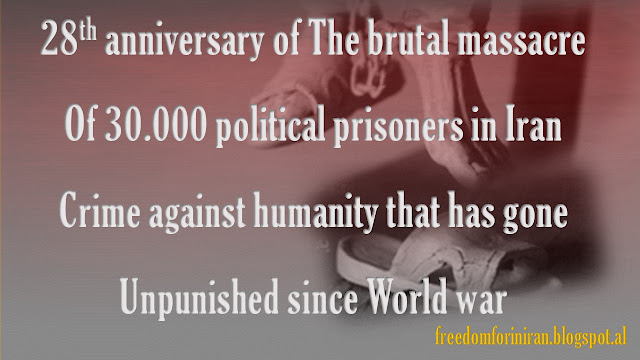
On the anniversary of the 1988 massacre of 30,000 political prisoners in IranThe 1988 massacre of over 30,000 political prisoners in Iranhas been described as the worst crime against humanity since World War II. [1]28 years after this genocide, the Iranian regime still refuses to acknowledge the executions, or provide any information as to how many prisoners were killed. Read more
The summer of 1988 is truly the darkest times in modern Iranian history. Some 30,000 political prisoners were executed under the direct and written order or Fatwa of Ayatollah Khomeini. The massacre is described as a political purge without precedent in modern Iranian history, both in terms of scope and cover up. Many of the prisoners were serving their prison terms and many were near the end of their sentences and were supposed to be freed. The massacre of political prisoners lasted a few weeks and their lifeless bodies were left inside unmarked mass graves in different cities and towns.
The majority of the victims belonged to the People's Mojahedin Organization of Iran or PMOI. Number of individuals who belonged to lefties and other groups were also executed. The PMOI exposed this political genocide for the first time in the same year just a few months after the massacre.
Every year the Iranian dissidents around the world commemorate those brave souls for they were taken from somebody's parents, sister, brother, son and daughter, aunt, uncle, classmate, colleague or teacher....
The wave of massacre of political prisoners began in late July and continued unabated for a few months. Anniversary of Khomeini’s fatwa which led to 1988 massacre in Iran
On the 27th anniversary of the massacre of 30,000 political prisoners,Maryam Rajavi pays tribute to the martyrs of the 1988 massacre of political prisoners in Iran Text of the speech
Amnesty International:Iran Desecrating mass grave site would destroy crucial forensic evidence
In other report Amnesty International on 1 June 2017 mentioned:
The desecration of a mass grave site in Ahvaz, southern Iran that contains the remains of at least 44 people who were extrajudicially executed would destroy vital forensic evidence and scupper opportunities for justice for the mass prisoner killings that took place across the country in 1988, said Amnesty International and Justice for Iran.
Photo and video evidence obtained by the NGO Justice for Iran and reviewed by Amnesty International shows bulldozers working on a construction project directly alongside the mass grave site at Ahvaz, as well as piles of dirt and construction debris surrounding the grave. Although the Iranian authorities have made no official announcements about Ahvaz, families learned through a construction worker that the plan is to ultimately raze the concrete block marking the grave site and build over the area.