Showing posts with label Sholeh Pakravan. Show all posts

Tuesday, June 20, 2017

June 20 1981-Beginning of the Iranian people's resistance for freedom

The 20th of June, commemorates the 36th anniversary of the birth of the Iranian Resistance to gain the most basic human rights of the Iranian people and to establish a democracy in Iran. On that day Khomeini himself gave the orders for the Guards Corps to open fire on half a million pro-democracy Iranians protesters

According to Mohammad Mohaddesssin, chairman of the NCRI’s foreign affairs committee and a veteran PMOI (MEK) official:
“From the start of the revolution we tried to have the regime reform. While Khomeini and other groups claimed that Iran’s main enemy after revolution was the US, we said the main threat and enemy to freedom is not the West; rather it is from religious fundamentalist forces in Iran who are gradually curbing all liberties. We tried to back liberal elements in the regime to weaken the hard-liners. Many of our sympathizers were arrested or killed during this period.
“June 20, 1981 marked the end of the regime’s toleration and any possible potential for reforms, and it has not changed since. The last reformist elements were eliminated from within the regime were purged at that stage. Since that day any Iranian or foreigner who has sought to find reformist elements in this regime has been searching for a mirage. We said this from the onset. The velayat-e-faqih regime is incapable of reform. If it were to halt the persecutions, tortures and executions for even one day and announce to the Iranian people that they would face no repercussions for their actions on that day, undoubtedly the people would topple the regime on that very day.”
This passage from the book ‘Democracy Betrayed’, published by the NCRI’s Foreign Affairs Committee offers a more in-depth understanding of the events leading to the beginning of the Resistance:
“Immediately after Khomeini seized power, a fundamental dispute surfaced between the Mojahedin [PMOI/MEK] and the clerical regime. Massoud Rajavi publicly named freedom as the Iranian people’s principal demand in the revolution which had toppled the shah. His remarks launched a nationwide campaign by the Mojahedin [PMOI/MEK] to defend democracy. From the outset, the regime organized hoodlums – the forerunners of the hezbollah – to heckle and harass Mojahedin [PMOI/MEK] supporters, and disrupt peaceful political activities. Not a day went by without attacks somewhere in the country on their gatherings and those of other current Council members, such as the National Democratic Front.
In January 1980, Khomeini issued a fatwa, vetoing Massoud Rajavi’s candidacy for the presidency. The French daily, Le Monde, [on March 29, 1980] wrote:
… According to diverse estimates, had Imam Khomeini not vetoed his candidacy in the presidential election last January, Mr. Rajavi, would have gotten several million votes. He was, moreover, assured of the support of the religious and ethnic minorities – whose rights to equality and autonomy he defended – and a good part of the female vote, who seek emancipation, and the young, who totally reject the “reactionary clergy”… The Mojahedin [PMOI/MEK] have not ceased denouncing, documenting and issuing calls about “the irregularities, pressures, fraud and violence” surrounding the first round of elections. 2,500 of their supporters were wounded, 50 of them gravely, by armed bands of “Hezbollah” in the course of the election campaign… Observers appointed by the Mojahedin [PMOI/MEK] who protested the election fraud were expelled from the premises, beaten, and sometimes arrested…
Another round of attacks on Mojahedin [PMOI/MEK] offices and gatherings followed, in which many of their supporters were killed or injured. In June 1980, Le Monde wrote:
… The objective of the popular gathering on Thursday afternoon, called by the People’s Mojahedin Organization of Iran [PMOI/MEK], was to protest against attacks on their supporters and activists in the past few days…
Tens of thousands of the party’s sympathizers had lined up at the entrance gates an hour before the gathering [at Amjadieh Stadium] when groups of Hezbollah began loudly protesting against the PMOI (MEK)… chanting, “There is only one party, the Party of God, and only one Leader, Imam Khomeini.”
The Hezbollah claims no precise political organization. They are notorious among the public as the shock troops… and serve as the tool of the extreme right faction of the Islamic Republic Party, directed by [Mohammad] Beheshti… The Hezbollah tried to prevent the gathering from taking place… They attacked the entrances to the stadium… The police and Revolutionary Guards for once observed strict neutrality. They did not turn their forces on the attackers, but they did protect them from the PMOI (MEK) 10 to 20 times more numerous… Things as they stand, the choice, according to observers, is between conciliation and civil war. [June 14, 1980]
Lines Are Drawn
“Our enemy is neither in the United States, nor the Soviet Union, nor Kurdistan, but right here, right under our nose, in Tehran.”
With these words, in late June 1980 Khomeini drew the lines. “Death to the Mojahedin [PMOI/MEK]” became the regime’s motto and Hezbollah stepped up its attacks on the organization’s centers, all legal. Two weeks prior, on June 12, 1980, in the famous speech, “What’s to be done?” at Tehran’s Amjadieh stadium, Massoud Rajavi had exhorted the crowd of 200,000 gathered in and out of the stadium, to “defend freedoms… freedom of speech, associations and gatherings.” The nonviolent resistance of thousands of Mojahedin [PMOI/MEK] supporters effectively frustrated the Pasdaran effort to disrupt the meeting with tear gas and live ammunition. Their assault left one dead, hundreds wounded and thousands beaten up, arousing the public’s sympathy for the Mojahedin [PMOI/MEK] and disdain for the regime’s crime. Even Khomeini’s son, Ahmad, condemned the Revolutionary Guards’ action as “treachery to Islam.” The Police Chief, Deputy Interior Minister and a number of Majlis deputies condemned the attack. A flood of letters and telegrams of condemnation from different political organizations, various sectors of society, and members of the business community were reprinted in the media, greatly alarming Khomeini. He had to make a choice: Either back down, or step up the political onslaught on the Mojahedin [PMOI/MEK]. A week later, the Mojahedin [PMOI/MEK] revealed a tape recording of a speech by Hassan Ayat, one of the leaders of the ruling party, in which he revealed the details of the plots. Khomeini hedged no longer, and on June 25, 1980, pointed his finger at enemy number one. The Mojahedin [PMOI/MEK], he said, “are worse than infidels.”
Even the organization’s health clinics soon came under attack. There were more deaths and injuries, and thousands of arrests. Responding to a letter of complaint by Mojahedin [PMOI/MEK] supporters in August 1980, when the organization still engaged in public activities, Mullah Allameh, head of the revolutionary court of Bam, in southern Iran, wrote: “According to the decree of Imam Khomeini, the Mojahedin [PMOI/MEK] of Iran are infidels and worse than blasphemers… They have no right to life.”
Mohammad Yazdi, head of the regime’s Judiciary, referred to Khomeini’s order to massacre the Mojahedin [PMOI/MEK] and their supporters, issued months before it became public, as follows:
The Imam’s hand-written judicial order condemned the Mojahedin [PMOI/MEK] – the totality of the organization and its infrastructure, and not individuals – so that there would be no hesitation in terming the activities by these individuals as waging war on God and corruption on Earth [and carrying out their execution orders].
Referring to the events of 1979-81, the [US] State Department acknowledges these facts in its December 1984 report:
The Mujahedin [PMOI/MEK] have never accepted the Khomeini regime as an adequate Islamic government. When Khomeini took power, the Mujahedin [PMOI/MEK] called for continued revolution, but said they would work for change within the legal framework of the new regime. The Mujahedin publications emphasized their unique role as an urban guerrilla force that promised to enter candidates for the highest offices under the new political system. The Mojahedin [PMOI/MEK] also entered avidly into the national debate on the structure of the new Islamic regime. The Mujahedin [PMOI/MEK] unsuccessfully sought a freely elected constituent assembly to draft a constitution.
The Mujahedin [PMOI/MEK] similarly made an attempt at political participation when Mujahedin [PMOI/MEK] leader Masoud Rajavi ran for the presidency in January 1980. Rajavi was forced to withdraw when Ayatollah Khomeini ruled that only candidates who had supported the constitution in the December referendum – which the Mojahedin [PMOI/MEK] had boycotted- were eligible. Rajavi’s withdrawal statement emphasized the group’s efforts to conform to election regulations and reiterated the Mojahedin [PMOI/MEK]’s intention to advance its political aims within the new legal system.
In March and May 1980, Rajavi and several other Mujahedin [PMOI/MEK] ran in Tehran for the Islamic Assembly (Majlis). Moussa Khiabani, Rajavi’s deputy, ran in Tabriz, and others ran in the north, where the group was strong. The Mujahedin [PMOI/MEK] attempted to demonstrate their broadened appeal by running on their ticket several moderate political figures…
Between the two election rounds, the Mujahedin [PMOI/MEK] announced that its members would disarm to prove that they were not initiating the clashes with the fundamentalists that had become endemic during the campaign. The fundamentalists responded by once again banning Mujahedin representatives from the university campuses. The group’s allegations that vote tallies had been altered to deny Rajavi and Khiabani victories, were ignored.
Rajavi then began to hint that the Mujahedin [PMOI/MEK] were considering active opposition to the Khomeini regime. In the early summer of 1980 the Mujahedin [PMOI/MEK] staged several rallies in Tehran drawing up to 150,000 people to hear Rajavi promise to carry on the opposition to fundamentalist domination.
On June 25 Khomeini responded by a major statement against the Mujahedin [PMOI/MEK], claiming their activities would derail the revolution and bring back “US dominance.”

For a year after Khomeini’s remarks, the Mojahedin [PMOI/MEK] continued to work for democracy through peaceful political means. This era ended on June 20, 1981, when heavily armed Guards turned a peaceful demonstration called in Tehran by the Mojahedin into a blood bath.

Thousands of Iranian women gave their lives for freedom
June 20 marks the beginning of the Iranian people's resistance for freedom and democracy in 1981.  Iran’s women pioneer their people's movement against the mullahs' religious dictatorship.
So, let us commemorate on this anniversary the tens of thousands of women who watered the sapling of freedom with their blood and persisted on their democratic demands since the beginning of the mullahs' rule in Iran. They chose to honorably resist at any cost but not succumb to the dictator and turned into shining stars who lit the dark night of their nation.
READ MORE
A letter by Sholeh Pakravan 
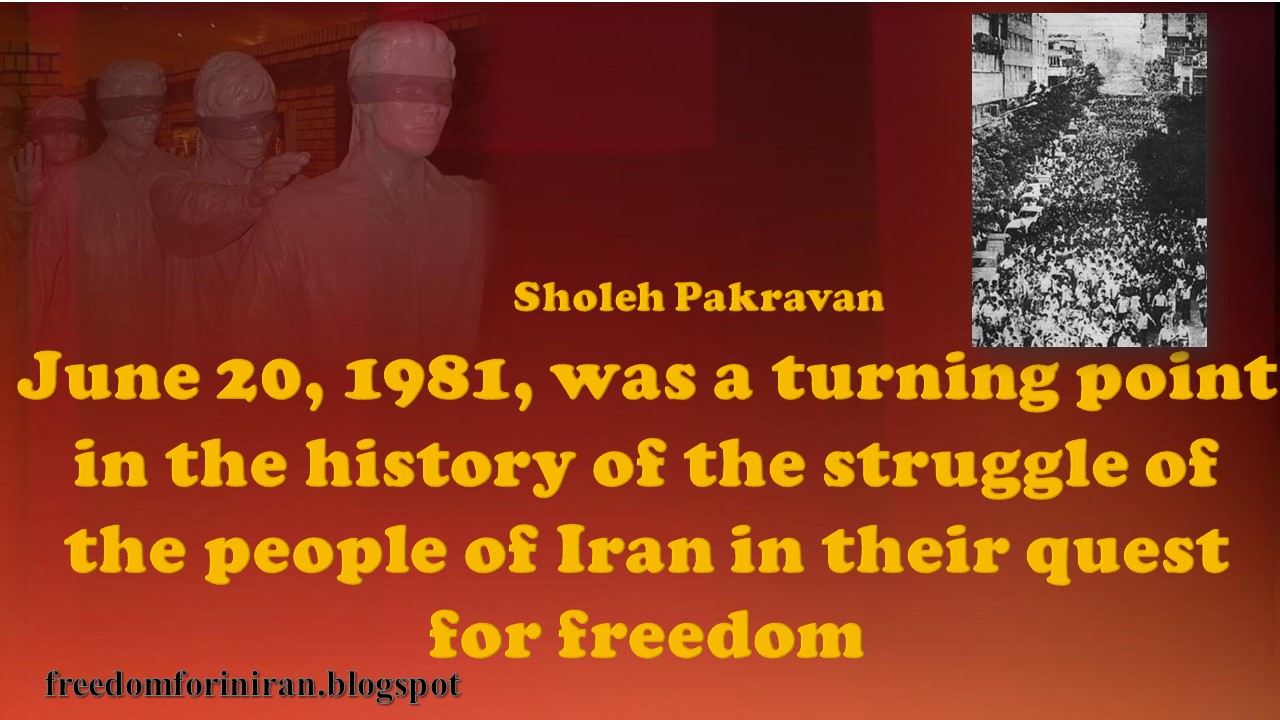
June 20, 1981, was a turning point in the history of the struggle of the people of Iran in their quest for freedom

Today, we are remembering political prisoners, both those who were killed in the past decades and those who are presently in prison.
Back on June 20, 1981, I was a teenager.
It was the day they opened fire on our people's demonstration.
Afterwards, only the names of young boys and girls who had been executed were announced in the newspapers.
The day turned into a turning point in the history of our people's quest for freedom...
Those days I didn't understand anything.
I didn't know the meaning of getting arrested and executed.
Arrest and execution were just two words for me and I didn't comprehend the extent of suffering hidden in just those two words.
READ MORE

Thursday, October 13, 2016

Iran: Mothers call for end to the death penalty

Shahin Mahinfar

Bereaved mother protests oppression of the ruling mullahs

Ms. Shahin Mahinfar posted a letter on October 13, 2016, saying that she could watch the video clip of how his son got killed for the first time after seven years.
Following is the text click here 

In another post she wrote: it’s Time for the Tyrants to Cry
Sholeh Pakravan

Iranian women and activist mothers who have lost their children under the mullahs' oppressive regime in Iran, spoke out against the executions in Iran on the World Day against the Death Penalty.
In a post on her Facebook, the anti-Death Penalty activist Sholeh Pakravan wrote, "No to executions, long live freedom. October 10 is a special day, the World Day against the Death Penalty. Because of the highest number of executions in our country, every day can be called a day to protest this naked violence. When we see bloodied (trace of noose around the) necks of those executed, we must protest and ask why? The world must also intervene. Combatting executions must have priority over any talk. It must be pre-condition to every deal. To combat the death penalty, we need national determination. The people of Iran must unite their voices and say: Executions are enough. No to executions. Long live freedom."
Shahin Mahinfar,

Ms. Shahin Mahinfar, mother of Amir-Arshad Tajmir who was killed by revolutionary guards in the 2009 uprising, also wrote, "Execution is a medieval sentence which is not appropriate for human beings. Our nation that has suffered loss many of her youths, cries out in one voice: No to executions; No to executions; No to executions."
Sholeh Pakravan

A chain of Mothers of Murdered Iranian Dissident


Tuesday, June 21, 2016

Iran- A chain of Mothers of Murdered Iranian Dissident

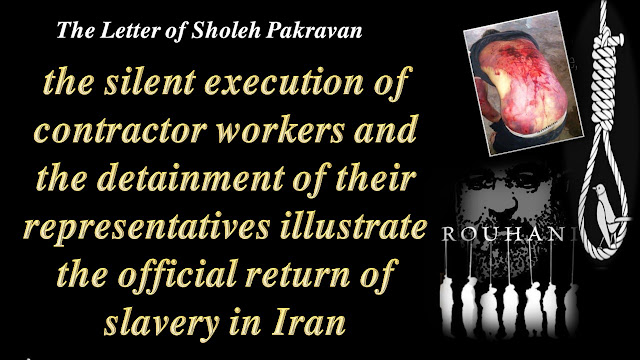
The Letter of Sholeh Pakravan
 The flame of resistance and struggle in the freedom movement has always been alive and it continues to burn in the face of Iran’s stifling dictatorship that holds the world’s record in executions.
Alongside the freedom fighters, there have always been young men and women who brave the obstacles and sacrifice their own lives in responding to the call of the movement.  Each of them shines like a star, piercing through the dark night of oppression and heralding the dawn.
Following in their footsteps with love and compassion, are their mothers, sisters, and relatives who deeply believe that their loved ones did not die in vain and need to continue their path until final fruition.
Certainly, the gushing pain and anger of mothers join together and become a devastating flood that will wash away the filth of the mullahs' religious dictatorship from Iran.
Read more about these mothers click here

Iran: Anniversary of Neda Agha-Soltan, symbol of the 2009 uprising 21 June 2016

Iran: Anniversary of Neda Agha-Soltan, symbol of the 2009 uprising 21 June 2016

Ms. Hajar Rostami commemorated her daughter on June 19, 2016, at her tomb while accompanied by a number of other bereaved mothers and relatives of those slain in the 2009 uprising.
Neda Agha Soltan was one of the thousands who were killed during the 2009 uprising. She was shot dead in Tehran’s Amir Abad district on June 20, 2009. A short film taken by a mobile phone and posted on the internet which showed her last moments, dying with her eyes open shocked the world and opened their eyes to the Iranian people's deep-rooted opposition to the ruling regime. Thus Neda became the symbol of the 2009 uprising.
The Letter of Sholeh Pakravan
Mother of Murdered Iranian Dissident Supports Political Prisoner Jafar Azimzadeh
Sholeh Pakravan, the mother of Reyhaneh Jabbari, has spoken prominently about the human rights abuses in Iran since her daughter was executed in 2014, and has now written an open letter of support to Mr. Azimzadeh.
Text of her letter

Read more: Iran: Women campaign to save life of hunger striking prisoner

Sunday, March 6, 2016

International Women’s Day-messages from inside Iran-Reyhaneh Jabbari’s Mother&Political prisoner Saleh Kohandel

International Women’s Day message of Reyhaneh Jabbari’s Mother

On the eve of International Women’s Day, Sholeh Pakravan, mother of Rayhaneh Jabbari- the young Iranian girl, that was sentenced to death and later executed despite international outrage, for defending herself against a rapist- sent a message to mark International Women's Day, March 8th and expressed her outrage at the Iranian mullahs' misogyny.

The message reads in part:

“On the occasion of March 8th, International Women's Day: I am a woman. A silent woman who has the cries of silent women from the depths of the history in her heart. I am a woman who has felt with my flesh and skin the suffering of the innocent girls whose right and justice seeking voices in their defense are not heard when they are raped. Because my child was in such a situation. I am a mother. The mother of the girl who went to the gallows unjustly.”

She goes on to say, “My Rayhaneh has now joined history. But her perseverance and insistence on truth and justice, has been a model for many girls. Oppressors abducted Rayhaneh from my arms and hanged her. Unaware that Rayhaneh's (basil) seeds were planted in the ground and thousands of green and fresh basil will grow from it.”

The National Council of Resistance of Iran (NCRI) stands in solidarity with the women of Iran who have had to go through such terrible exploitation and oppression. On Saturday, February 27, 2016, on the eve of the International Women’s Day, a grand gathering entitled, “Pledge for Parity: Women United against Fundamentalism” was held in the presence of the Iranian Resistance's President-elect Maryam Rajavi and a number of political dignitaries, intellectuals, prominent personalities, and activists of the equality movement from 26 countries and four continents.

She said that, "Mandatory veil, is an all-inclusive and permanent tool for suppression of women. In a matter of only one year, 3.6 million women were inspected and questioned on the streets for "improper veiling" and 18,000 women were put on trial.”

The NCRI is of the view that the common practice of violence and rape against women and widespread addiction and misery of women are among products of the mullahs' corrupt Sharia.

In Iran under the rule of the mullahs, polygamy, anti-human treatment of women and girl children, sexual abuse of girl children under 9 years of age are justified and imposed on women. Mrs Rajavi said that the Velayat-e Faqih is a senseless monopoly that is confronting women's equal rights full force. “They have turned Iran into a big prison for women.”

Women are the main victims of fundamentalism in Iran. The NCRI supports theirs struggle against oppression. With solidarity and unity of action, they can play a significant and key role in combatting the excesses of the Iranian regime

Iran: Political prisoner’s message to his daughter in exile on the occasion of International Women's Day

Mr. Saleh Kohandel, a political prisoner currently held in a notorious prison in Iran has written a letter marking March 8th, International Woman’s Day to his daughter, Paria, who managed to secretly exit Iran last year and join the main Iranian opposition movement, the People’s Mojahedin Organization of Iran (PMOI/MEK).

“I congratulate my daughters, Paria, and Zahra, and all your colleagues from inside the dungeons of the fundamentalist mullahs’ prisons. I say loud and clear: Thousands and thousands of salutations to you for choosing such a beautiful path and said no to the reactionary culture of the mullahs… congratulations to you

Of course, I was certain that none of the chains and restrictions of their culture could not keep you in their grasps. About me, don’t be worried because I have placed my entire cause to you, my spirit is with you and only my physical body is imprisoned by the inhumane mullahs, which itself is not very important. Now the mullahs’ regime is seeking to decay my body in solitary confinement, hang me like [PMOI member] Mr. Saremi, or have me murdered like my heroic friend, Shahrokh Zamani.

My girl, Paria, on such a beautiful day (International Women’s Day), which the misogynist mullahs cannot even tolerate as their ancestors buried girls alive and now they are splashing acid on innocent women’s faces, I am asking you to on my behalf congratulate those who are struggling for the freedom and liberation of Iranian women from the fundamentalist mullahs. It doesn’t matter what religion they may believe in.

And to those appeasing the mullahs, tell them to not waste their time because the future is ours and the mullahs will be defeated.
May victory be yours
Saleh Kohandel
Gohardasht Prison of Karaj – March 20 16

Related:
Annual Book: Iranian Women in 2015


.

Wednesday, February 10, 2016

Iran: Mothers, families of martyrs and political prisoner on trial

Iran: Mothers, families of martyrs and political prisoner on trial

A group of women protest the detention and imprisonment of political prisoners in Iran

The trial of 10 men and women, mothers, fathers and relatives of martyrs and political prisoners, was held on Tuesday February 9.
These people were mostly arrested during a peaceful gathering outside Evin Prison on January 20, 2016, and charged with “disrupting public order”.
Simin Eivaz Zadeh (mother of ex-political prisoner Omid Alishenas), Hashem Zeinali (father of missing student Saeed Zeinali thought to be murdered in 1999 uprising) and a number of Mohammad Ali Taheri’s followers were present before the court.
Mothers of martyrs and political prisoners staged a picket and carried placards to show their solidarity with those on trial.
Sholeh Pakravan (mother of executed interior designer Reyhaneh Jabbari), Shahin Mahinfar (mother of Amir Arshad Tajmir - killed during the 2009 uprising), Akram Neghabi (mother of Saeed Zeinali- thought to be murdered in the 1999 uprising), Hoori Golestani (mother of Behnood Ramezani - killed in the 1999 uprising), Mansoureh Behkish, Mother Osanloo and Shahnaz Karim Beigi (mother of Mostafa Karim Beigi - killed during the 2009 uprising) were present in this protest.
Sholeh Pakravan wrote on her facebook account: “I can see with my heart that my country is bearing big news.”
 Sholeh Pakravan (mother of executed interior designer Reyhaneh Jabbari),
Sholeh Pakravan (mother of executed interior designer Reyhaneh Jabbari)
 Akram Neghabi (mother of Saeed Zeinali- thought to be murdered in the 1999 uprising)
Akram Neghabi (mother of Saeed Zeinali- thought to be murdered in the 1999 uprising)


Thursday, November 19, 2015

Solidarity with victims of Paris attacks,messages from the victims of fundamentalism of Mullah's regime, inside Iran

Following the Paris terror attacks, Iranian activities and some mothers of those that their children was killed by Iran brutal regime has condemned the Paris Attacks and has sent their solidarity message to the French people.


Gohar Eshghi, His sun,Sattar Beheshti,was a blogger that killed,under torture, has strongly condemned the violence
she wrote:
We expect  the West governments not to shake the hand with the murderers and stop appeasement,with state sponsors of violence and terror


 Sholeh Pakravan, mother of Reyhaneh Jabbari who was executed in Iran in October 2014 after she defended herself to rape, sent a message to the people of France expressing her sympathy and condolences.

Also Nasrin Sotudeh, a renowned Iranian human rights lawyer and advocate, sent a message to the people of France on her Facebook page, expressing her condolences.

Tuesday, October 13, 2015

Iran-Mrs. Sholeh Pakravan, Reyhaneh Jabbari’s:NO 2 EXECUTION, period


Sholeh Pakravan at Reyhaneh Jabbari gravesite

Mrs. Sholeh Pakravan, Reyhaneh Jabbari’s mother talks on the occasion of Oct. 10th the World Day Against Execution. She calls on those who execute people under the banner of the so called 'Justice' and those who see this horrifying and disgusting scene of a man or a woman battling for their life on the end of the rope, be it in public or inside prisons.
Mrs. Pakravan, as she claims, is an advocate of No to execution, since her own daughter, Reyhaneh was hanged last year on Oct. 25th for a so called crime that is in every man and woman’s right, in defense of her honor against a sexual assault by an Iranian intelligence ministry officer.
Mrs. Pakravan says come to me to tell you a bitter story, perhaps you would wake up and join our hands and be a part of those who oppose execution. Perhaps your dreams would become our dreams of an Iran without execution, an Iran without the death penalty.